How to Make a Steel Service Center More Efficient
Find the constraint, usually the slitter, then cut the setup time, scrap and paperwork around it. A practical efficiency plan for a steel service center.

LineSight
October 27, 2026
A steel service center gets more efficient by finding the one machine that limits how many tons leave the building and protecting its hours. On most flat-rolled floors that machine is the slitter. Cut the setup time and scrap it spends, shorten the paper chain that feeds it orders, and track the result in tons shipped per slitter hour and in yield, the share of each coil that ships as product. On the office side, the number to watch is the hours between a customer's PO arriving and its work order reaching the floor.
Most of the work is shop discipline and costs little beyond attention. The planning and the order entry are where software earns its place, and LineSight AI is built for those two jobs: it builds slitting plans from open orders and live coil inventory, and it keys POs into the ERP so nobody has to retype them. If the economics of a service center are new to you, what a metal service center is and why efficiency defines it is a shorter place to start.
Where is a service center actually losing time and money?
Measure for one week before fixing anything. Opinions about where the time goes are usually right about the symptom and wrong about the size. Four numbers are enough to start: yield per pattern (shipped pounds over coil pounds), knife changes per shift with the minutes each one took, hours from PO received to work order released, and days of inventory on hand by product.
Most of this is already in the ERP or on the floor's paperwork. Setup minutes are the exception. Few shops record them, so have the operator write a start and end time on the work order for every changeover. A clipboard is fine. One week of that tells you more about your capacity than any annual report.
Is the slitter your bottleneck?
Probably, if coils queue in front of it while the cut-to-length line or the packaging crew has slack, and if overtime goes to slitting while the other lines finish early. The useful idea here is old. Eliyahu Goldratt's The Goal (1984) set out the theory of constraints: every plant has one step that limits its output, and only by increasing flow through that step can the plant's throughput go up. An hour gained on a line with slack is worth nothing to the plant. An hour lost on the constraint is lost to the whole plant.
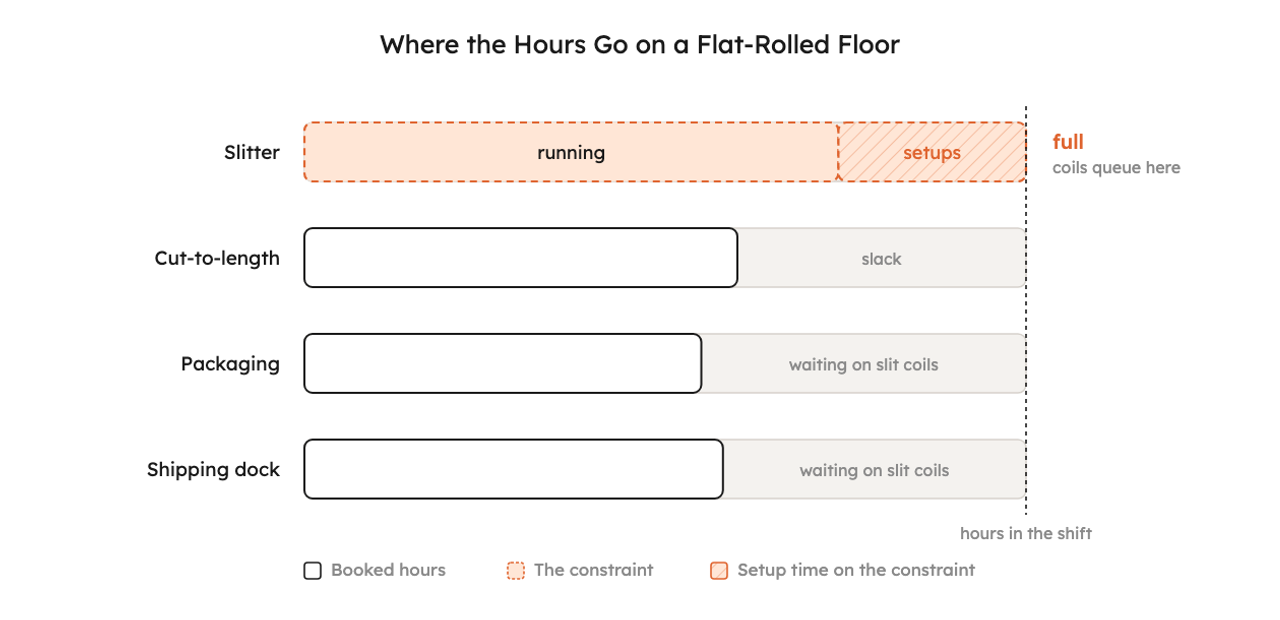
That changes what counts as an improvement. A faster packaging line or a second shift on the CTL ships no more tons while the slitter is full. Look at your one-week log. If the slitter's hours are booked and the others are not, everything that follows in this guide should be judged by the slitter hours it frees.
How do you get more out of the slitter without buying another one?
Start with setup, because setup is the part of the slitter's day that produces nothing. Shigeo Shingo's single-minute exchange of die work splits a changeover into internal steps, which can only happen with the line stopped, and external steps, which can happen while it runs. Toyota used the method to take die changes from hours to minutes. On a slitter the external work is building the next knife and spacer stack on a second arbor or a knife cart, staging the next coil at the entry end, and having the work order and the strip widths checked before the current coil finishes. If any of that happens while the line is stopped, it is costing the plant output.
Sequence matters as much as speed. Patterns that share a knife arrangement should run back to back, and the plan should be built the day before so the floor isn't waiting on it at 7:00. Prove out the first piece with a burr and width check before running the full coil, so a bad setup costs a few feet instead of a coil.
Here is the arithmetic, with example figures. Say a slitter runs two shifts, does six setups a day at 40 minutes each, and averages 20 tons an hour when it is cutting. Setups take four of its sixteen hours. Cut each changeover to 25 minutes and the line gets 90 minutes a day back, or 30 tons of capacity, with no new equipment. Over 250 working days that is 7,500 tons. The machine half of slitting, from knife clearance to tension, is covered in our guide to reducing scrap on a slitting line.
How much is scrap really costing you?
More than the percentage suggests, because a scrapped ton loses its full purchase cost and recovers only scrap value. At 50,000 tons a year, one point of scrap is 500 tons. US hot-rolled band was $1,188 per net ton FOB the mill on October 14, 2026, per SteelBenchmarker report #492. If your scrap buyer pays $250 a ton, each scrapped ton loses $938, and one point costs $469,000 a year. Those are example figures; the scrap calculator runs the same formula on yours, and what one point of slitting scrap is worth walks through why it comes straight off gross margin.
Scrap is also a slitter-hours problem. Every foot of drop was run through the constraint at full speed and then thrown away. A pattern that closes a 10-inch drop with a strip from another order ships more tons from the same coil and the same hour of line time.
Why does an order take a day to reach the floor?
Because it gets retyped. A customer's PO arrives as an email or a PDF, someone keys it into the ERP, the planner exports it into a spreadsheet, and the finished plan goes back into the ERP by hand as work orders. We counted the steps in the ten touches between a PO and a release, and most of them move information the business already has.
Each retype adds delay and a chance of error. An order still sitting in the inbox when the morning plan is built misses that plan, and the strip it carried can't fill tomorrow's drop. Typing mistakes are measurable too: when researchers compared hand-entered clinical test results against the same results sent electronically, 3.7 percent of the manual entries did not match. An order desk is a different setting, but a width keyed wrong at a service center gets slit, wound and tagged before anyone compares it to the PO again. Twenty orders and five timestamps each will tell you where your delay sits; what manual order handoffs cost lays out how to run that audit.
What should you carry, and what should you stop carrying?
Inventory is cash on the floor, and coil that doesn't nest with the order book also costs slitter hours, because awkward widths make worse patterns. Steel Market Update put US service center flat-rolled stocks at 44.5 shipping days of supply in June 2026. For a shop shipping 50,000 tons a year over about 250 shipping days, every ten days of supply it can drop is roughly 2,000 tons, or about $2.4 million at the October HRB price.
Two habits help most. Trend remnant and secondary stock older than 90 days, and give each remnant a named order at plan time or sell it. Then buy master widths that nest with your repeat orders, which may not be the widths that look standard. A remnant parked for later that ages out of spec was scrap the day it was cut.
Where does software help, and where doesn't it?
Software won't sharpen a knife or stage an arbor. The ERP already keeps the record of orders, tags, heats and invoices, and it does that well. The hours go into two jobs that sit outside it: searching the order book against the coil inventory for the best plan, and moving POs into the system by hand. Both are mostly repetitive and both touch the constraint, which is why we built LineSight AI for them. It reads open orders and live coil inventory, returns complete slitting plans with the scheduler keeping the final say, and enters customer POs as sales orders, along with mill and outside-processing POs, into the ERP. It is live with PS Data, INVEX and Eniteo, and connects to virtually any ERP.
Elite Steel cut its scrap rate by 2.9 points and added $850K in annualized revenue after going live with LineSight AI. That is one operation with its own order mix, so measure your own week first and price what you find against your own tonnage.