What Do Manual Order Handoffs Cost a Service Center?
One order can be retyped by hand five times between the PO email and the truck. What that costs a service center, and how to measure it with 20 orders.

LineSight
October 6, 2026

Manual handoffs cost a metal service center in three ways: orders that miss the day's plan because nobody has keyed them in yet, typing mistakes that get slit into scrap, and hours spent retyping data and chasing its status. A single order can be typed by hand five times between the customer's PO email and the truck. Replacing those handoffs means software reads the order where it arrives and carries it through the ERP, the slitting plan and the work order, while a person approves each step instead of retyping it.
Most shops know they retype too much. Very few have counted the handoffs on a single order, and fewer still have put a number on what they cost. Each step in the order flow is well understood by the person who does it. What rarely gets measured is the cost of moving the order from one step to the next.
Six handoffs between the inbox and the truck
Follow one four-line order for galvanized strip. The customer's PO arrives as a PDF in a shared inbox, and someone at the order desk reads it and keys the header and lines into the ERP's order entry screen. The planner then exports open orders and coil inventory from the ERP and pastes them into the spreadsheet where plans actually get built. Once the plan is settled, it goes back into the ERP by hand as work orders, one per setup. The work order is printed for the slitter, and if part of the job goes out to a toll processor, its details are typed again into an email to the processor. Whatever the coil inventory cannot cover becomes a note to purchasing and, later, an RFQ that a buyer writes up from that note. Finally someone calls or emails carriers for the release, writes down the quotes and books the truck.
Of those six handoffs, five move information the business already has from one screen or document into another. Only the freight step brings in something new, the carriers' prices. The full flow, with every step and who owns it, is laid out in from PO to release. The arrows between those steps are where the money leaks.
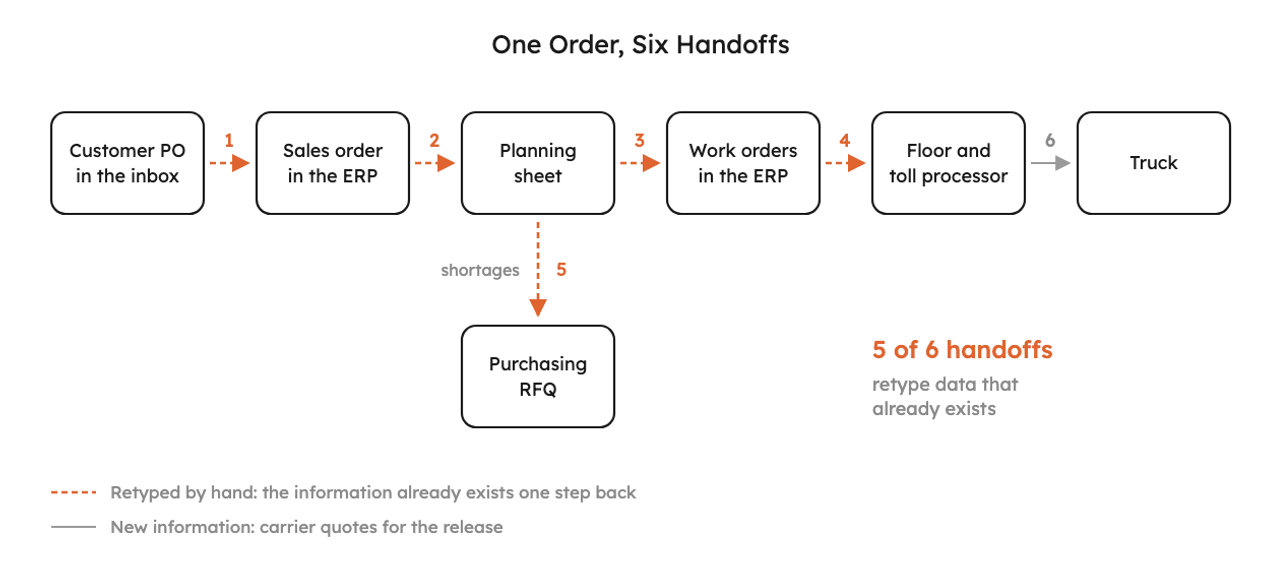
The order that missed the 7:30 plan
A plan can only see orders that are already in the ERP. If the morning plan is built at 7:30 and a PO sits unkeyed in the inbox until 10:00, that order waits for tomorrow's plan or forces a re-plan in the middle of the shift. Either way the customer's lead time has grown by a day for a reason that has nothing to do with the line.
The less obvious cost lands on the other orders. Slitting yield depends on which widths are in the book together when the plan is built. Say a 60-inch master coil is set up at 8:00 for four 12.25-inch strips. After a quarter inch of edge trim on each side, that leaves a 10.5-inch drop. The order that was still sitting in the inbox might have carried the 9.5-inch strip that would have filled most of that drop. Instead the drop goes to the scrap bin, and the 9.5 gets cut tomorrow from a different coil with its own leftover. The guide to reducing scrap on a slitting line works through that arithmetic in more detail. A late handoff makes one order late, and it quietly makes the plan worse for every order around it.
A typo with a coil attached
Every retype is a chance to swap two digits. In most businesses a wrong number on an order ends in a credit memo. In a service center, a width keyed as 3.75 instead of 3.57 gets slit, wound and tagged before anyone compares it to the PO again, and by then the strip is material bought at full price that fits no order. The mistakes that hurt most tend to sit in units and tolerances: a price per hundredweight read as a price per pound, a gauge range flattened to one nominal value, a maximum coil weight left off because the entry screen had no field for it.
Careful people still mistype. One of the cleaner measurements of how often comes from healthcare. When researchers compared hand-entered point-of-care test results in outpatient clinics against the same results sent electronically, 260 of 6,930 manual entries, or 3.7%, did not match. An order desk is a different setting and its rate will be different too. The lesson that carries over is that trained people copying numbers by hand get a few of them wrong, and an order that is retyped five times gets five chances at it.
Twenty orders and five timestamps
Time is the cost everyone feels and almost nobody adds up. Each handoff takes a few minutes, spread so thinly across the day that it never shows up as a line item. Chasing is worse. When an order's status lives in five places (the inbox, the ERP, the planner's sheet, the floor and the toll processor's email), nobody can answer a customer's "where's my order?" without asking someone else, and each call turns into a walk to the floor or a phone call to the processor. None of this was designed. Customers send POs however they like, the ERP keeps an accurate record once an order is in it, and every spreadsheet in between was a sensible local fix.
You don't need new software to find out what all of it costs you. Pick 20 orders received this week, from your normal mix of customers and channels. For each one, write down five timestamps: when it arrived, when it was keyed into the ERP, when it first appeared in a plan, when its work order was issued and when it shipped. The gap between arrival and entry is your entry delay. The gap between entry and plan tells you how often orders miss the next plan, and by how much. Then count, for each order, how many times someone typed something that already existed somewhere else, and how many fields were corrected after entry, marking the corrections that came after the coil was cut. For the same week, keep a tally at the order desk of every status call and email.
Then put a dollar figure on the worst of it. Any entry error that reached the slitter is material cost that belongs in your scrap number, and the scrap calculator shows what that number is worth at your tonnage. Whichever handoff the audit flags, PO to sales order deserves a close look first, because every later step waits on it.
Approving instead of retyping
Replacing the handoffs does not mean taking people out of the flow. It means the order is read where it arrives, in the email or in the ERP, and carried forward by software: the sales order is entered from the PO, the plan is built from the open orders and the coil inventory as they stand right now, including the order that landed at 10:00, and the approved plan becomes work orders without anyone typing it a second time. The person who used to retype the order checks it against the source and approves it. The planner who used to rebuild the spreadsheet reviews a plan that shows what is cut from which coil and why, and changes it where the floor knows better.
That is the model behind LineSight AI's Command Center. It reads orders from email and the ERP, enters sales orders, builds slitting plans from open orders and live coil inventory in seconds, creates work orders and books freight, and a person approves before anything goes into the ERP or to the floor. Planner overrides are kept, and later plans respect them. LineSight is live with PS Data, INVEX and Enmark, and connects to virtually any ERP.
If you run the 20-order audit and want to see those same orders carried through without the retyping, book a demo; the first three months are free.