From PO to Release: What Actually Happens in a Metal Service Center, and What Can Be Automated
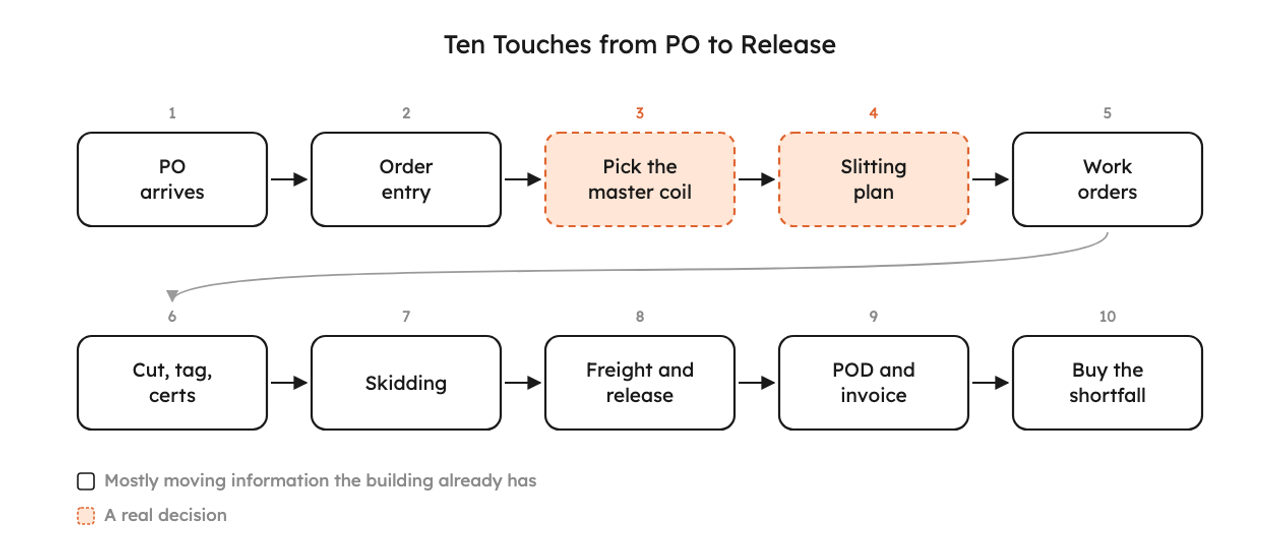
A flat-rolled service center runs ten steps from PO to release. Here is what each one costs today, and which ones can be automated safely.
Bilal Yousuf
September 2, 2026

A purchase order lands in an inbox at 7:04 AM. Between that moment and a truck leaving the dock, a flat-rolled service center will touch that order ten separate times. Most of those touches are a person retyping something a computer already knew.
That is where the money goes. Not one big broken process, but ten small handoffs that each cost a few minutes and occasionally cost a coil.
What follows is that flow, step by step. For each: who does it today, what it costs, what good looks like, and what can safely be automated versus what should stay a human decision.
Quick answer
Make a metal service center more efficient by removing the manual handoffs between order arrival and truck departure. Stop re-keying the same order into email, ERP, spreadsheet, and work order. Optimize the slitting plan with software instead of a scheduler's memory. Keep humans on the judgment calls: pricing, credit, customer promises, and material substitutions.
The ten steps
1. The order arrives
Who does it today. Inside sales or a customer service rep. Orders arrive as email attachments, PDFs, faxes that became PDFs, phone calls written on a pad, texts with a photo of a spec sheet, and, for the larger accounts, EDI.
What it costs. The arrival costs nothing. The variance costs everything. An EDI order is structured data. A phone order is one human's transcription of another human's memory. Both land in the same order book, but only one is trustworthy without a second read. The other cost is latency: an order that sits in an inbox for four hours missed today's plan and lands in tomorrow's, which is how a two-week lead time quietly becomes three.
What good looks like. Every inbound channel drops into one queue, timestamped, with the source document attached. Nothing lives only in someone's inbox.
Automate. Reading the channel, extracting customer, part, gauge, grade, width, weight, and due date from a PDF or a photo, and putting it in the queue. This is now reliable enough that the queue can build itself. AI order entry for metal service centers covers how that extraction actually works and where it fails.
Keep human. Accepting the order. Extraction is a draft, not a commitment.
2. Order entry, credit, and pricing
Who does it today. Inside sales types the order into the ERP, line by line. Someone checks the customer against a credit hold. Someone confirms the price against a quote, a contract, or last month's number.
What it costs. This is the most re-keyed step in the building. The information already exists in the customer's PO. It gets typed again. Every typed field is a chance to move a decimal, and here a decimal is a gauge. A 4.250 entered as 4.520 does not fail at entry. It fails three days later, on a coil that has already been slit.
What good looks like. Order entry is a review screen, not a typing exercise. Fields arrive pre-filled from the source document and the operator confirms or corrects.
Automate. The keystrokes. Sales orders, purchase orders, and outside processing orders can all be entered by software driving the ERP, with the operator approving the result. Credit-hold and price-list lookups are data retrieval and should never occupy a person.
Keep human. The exception. When the price does not match the quote, or the customer is over their limit, that is a commercial conversation, not a rule.
3. Material matching: which master coil do we pull?
This is the first genuinely hard decision in the flow, and the one most people underestimate.
Who does it today. A scheduler or a planner, working from the open order book and a coil inventory list, usually exported into a spreadsheet.
What it runs against. An order line carries a gauge, a grade or coating class, a finished width, a weight, and a due date. A master coil carries a gauge, a grade, a width, a weight, an ID and OD, a PIW, an edge condition, and a location. Matching them is not a lookup. It is a search across every open order and every coil in the building at once, because the right coil depends on what else you can cut out of it.
What it costs. Time, and the wrong answer. A planner working coil by coil finds a coil that works. Whether it was the coil that should have been opened is a different question. Pulling a prime 60-inch master to cut one 4.250-inch order looks fine on the work order and terrible on the month-end yield report.
What good looks like. Material matching and slitting plan are decided together, not in sequence. You do not pick a coil and then figure out the pattern. You evaluate coil-and-pattern combinations and pick the pair.
Automate. The search. The number of viable order-to-coil combinations across a real order book is far beyond what anyone can hold in their head. LineSight evaluates far more order-to-coil combinations than a human planner can, across the whole order book and inventory at once.
Keep human. Substitution judgment. "Will this customer take the heavier gauge this once?" is a relationship question. So is "do we open the aged coil or keep waiting for a better fit?"
4. The slitting plan and the schedule
Who does it today. The most experienced scheduler you have. Often one person. Often the only person who can do it.
What it costs. This is where the scrap rate is set, days before any metal moves. It is also where planner hours disappear. On most floors this is a daily block of your most experienced person's morning, repeated every week of the year. Measure it on your own desk before you believe anyone's figure, ours included.
Why it is hard. It is not a scheduling chore. It is the cutting stock problem, a formal combinatorial problem that has resisted a clean general solution for sixty-five years. The history is in The 65-Year-Old Math Problem Running Your Slitting Line. A human can evaluate dozens of arrangements before the shift starts. The real search space runs to millions.
Why your ERP does not do this. An ERP is a system of record. This is a system of decision. Different software, different jobs. That is the subject of Why Your ERP Can't Plan a Slitting Line.
What good looks like. A plan produced in seconds, not hours, that respects every real constraint on your floor: knife setups, min and max mults, width tolerances, PIW, edge conditioning, multi-pass, slitter capability, line speed, skidding rules, must-ship orders, and lead times. A plan that ignores any one of those is not a plan. It is a suggestion the floor will overrule.
Automate. The search and the arrangement. Completely. The levers it is searching over are set out in our 12-point checklist for reducing scrap on a slitting line, and the terms in the glossary.
Keep human. Approval. Every override is information: the scheduler telling the system something about the floor that was not in the data. Keep the human in the approve seat, and treat overrides as worked examples rather than errors.
5. Work orders to the floor and to toll processors
Who does it today. The planner, again, translating the approved plan into work order records in the ERP, then printing them, then walking them out.
What it costs. Pure transcription, and a second chance to introduce the error you avoided in step 2. Outside processing is worse: an OPPO usually means an email to a toll processor with a spreadsheet attached, then a week of asking where it is.
What good looks like. The approved plan becomes work orders without anyone retyping it, and outside processing orders leave the building through the same path as internal ones, with the same tracking.
Automate. Creating and distributing the work orders, internal and external. The approved plan already contains everything a work order needs.
Keep human. Same-day sequencing. If a slitter goes down at 10 AM, someone who can see the floor decides what moves.
6. Processing, tagging, genealogy, and certs
Who does it today. The operator runs the setup and tags each finished coil. The shipping office pulls the mill test report for the master and attaches it to the outbound paperwork.
What it costs. Genealogy is the expensive one when it goes wrong. If a finished coil cannot be traced to its master, you cannot produce a cert, and in some markets you cannot ship at all. Shops that do this by hand do it correctly until the day they do not.
What good looks like. Parent-to-child linkage is recorded at production, not reconstructed afterward from a work order and a memory. Certs attach automatically because the lineage is already in the system.
Automate. The record-keeping and the cert attachment. Both are deterministic once genealogy is captured.
Keep human. Physical inspection. Nobody should automate a call on edge damage or a telescoped coil that a person is standing in front of.
7. Skidding and packaging
Who does it today. The floor, working from customer-specific rules that live in someone's head or a note field on the customer master.
What it costs. Less than the other steps, but it constrains them. Max skid weight and configuration change how many coils fit on a truck, which changes freight cost, which changes the margin on the order. A plan built without skidding rules produces a load that gets rebuilt on the dock.
What good looks like. Skidding rules are a planning constraint, not a shipping afterthought. They belong in the plan.
Automate. Applying the rules and calculating the load.
Keep human. Anything unusual the customer asked for verbally last quarter and never put in writing.
8. Freight quoting, carrier selection, release, and BOL
Who does it today. A traffic coordinator, or in smaller shops the same person who did steps 1 through 7. They call or email three carriers, wait, compare, pick one, and send a release.
What it costs. The waiting: an hour of quote latency on every load, several loads a day. And the shortcut: when you are behind, you do not call three carriers, you call the one you always call. Defensible under time pressure, expensive a hundred times a year.
What good looks like. Every load gets quoted by multiple carriers, every time, without anyone spending an hour on it. Freight cost is visible while the plan can still change.
Automate. Soliciting quotes, collecting them, comparing them, and sending the release once a carrier is chosen. This is one of the clearest wins in the flow, because it is a pure market operation on a deadline.
Keep human. The pick, when it matters. The cheapest quote and the right carrier are usually the same thing. When they are not, the difference is service history, and that is a judgment call.
9. Shipment, POD, and invoicing
Who does it today. Shipping generates the BOL. The carrier delivers. Someone chases proof of delivery. Accounting invoices, usually in a batch.
What it costs. Days of cash. An order that shipped Tuesday and invoiced the following Monday is five days of working capital you financed for free, on every order.
What good looks like. POD lands against the shipment record automatically, and invoicing triggers off it rather than off a weekly run.
Automate. POD capture and invoice triggering.
Keep human. Disputed deliveries and short shipments.
10. Purchasing the shortfall
Who does it today. A buyer, working from a shortage list the planner produced as a byproduct of step 4.
What it costs. Timing. The list is accurate at the moment the plan is approved and stale as soon as the next order lands. Buyers working from a stale list buy material the plan no longer needs, which is how aging inventory starts.
What good looks like. The buy list falls out of the plan automatically. What inventory could not cover becomes an RFQ the same morning, not the following week.
Automate. Producing the shortfall list from the approved plan and sending RFQs to mills and brokers, whether that is a mill list or a blind bid.
Keep human. The buy itself. Price negotiation and supplier relationships are the buyer's job.
Where the margin actually goes
Service center margins are thin by construction. You buy metal, change its shape, sell it. Ryerson, one of the largest service centers in North America, reported an 18.4% gross margin in Q1 2026, before warehousing, delivery, selling, general and administrative expense, which was $265.2 million that quarter. Whatever survives that is the business.
Five things eat into it, roughly in order of size:
- Scrap. The largest and the most controllable. Every point of yield is money that was already paid for at mill prices. At a mid-sized operation running tens of thousands of tons a year, a single percentage point of scrap reduction is a six-figure sum in recovered material value. Work it out with your own tonnage and your own average cost per ton rather than a headline price.
- Planner hours. Not the wage cost, the opportunity cost. Your most experienced person spends the morning doing arithmetic instead of handling the accounts and exceptions only they can handle.
- Re-keying errors. Individually small, occasionally catastrophic. A mis-keyed width is discovered after the coil is cut.
- Aging inventory. Material bought against a plan that changed. It carries, it takes floor space, and eventually it sells at a discount or gets cut into something it was never bought for. US service centers carried 45.6 shipping days of flat-rolled sheet supply in July 2026, per Steel Market Update. That is an average, not a target.
- Freight overpay. The tax on being busy. Every load booked with the familiar carrier instead of the best one.
None of these show up as a line item. That is precisely why they persist.
What this looks like when it is actually connected
Elite Steel runs this flow with LineSight. Reported results: +$850K in annualized revenue added, a 2.9% average scrap-rate reduction, and a +20% gross profit margin increase. Abizer Ghadiali, VP at Elite Steel: "LineSight has taken the guesswork away from trying to maximize a coil… because of LineSight, my employees are working more efficiently, and we're making more money on every coil."
The point is not the tooling. It is that the ten steps stop being ten steps. The order arrives, gets entered, gets matched to material, gets planned, becomes work orders, gets freighted and released. It becomes one continuous flow, with a person approving the decisions that need a person. That is what the LineSight Command Center is built to do. It goes live in under a month, including the dedicated integration for whatever ERP you already run, and the first three months are free: we measure the savings on your live orders in that window, and we never charge more than we save.
The rule for deciding what to automate
Automate the steps that are search or transcription. Keep humans on the steps that are commitment or relationship.
Transcription is anything where the information already exists and a person is moving it: order entry, work orders, cert attachment, BOL generation. There is no judgment in it, and every repetition is a chance to be wrong.
Search is anything where the answer requires evaluating more combinations than a person can hold: coil selection, pattern generation, carrier comparison. People are not bad at these for lack of skill. They are bad at them because the search space is too large for any brain.
Commitment is anything you would have to walk back in front of a customer: accepting an order, agreeing a price, promising a date, substituting material. Relationship is anything where the right answer depends on history the data does not contain.
Get that division right and efficiency stops being a project. It becomes how the building runs.
For the economics underneath all of this, start with What Is a Metal Service Center and Why Does Efficiency Define the Business. For the software category that runs the connected version, see what a command center for metal processing is.
Frequently asked questions
How do I make my metal service center more efficient?
Remove the manual handoffs between order arrival and truck departure. Most service centers do not have one broken process. They have ten small ones that each cost minutes and force people to re-key data that already exists. Fix the slitting plan first, because it sets your scrap rate. Then eliminate the transcription steps: order entry, work order creation, freight quoting.
How many hours do planners waste building slitting schedules?
It varies with order book size and product mix, but on most floors it is measured in hours per day rather than minutes, and it falls on the one or two people who can do it. The honest way to size it is to time your own planner for two weeks. The real cost is not the wage hours anyway. It is that your most experienced person spends the morning doing combinatorial arithmetic instead of running the operation and handling the accounts only they can handle.
How do service centers decide which master coil to pull for an order?
Today a scheduler compares the order's gauge, grade, width, weight, and due date against coil inventory and picks one that fits. The better method decides coil and cutting pattern together, because the right coil depends on what else can be cut from it. That means searching order-to-coil combinations across the whole open order book at once — a computational problem, not a lookup.
Can AI actually run a slitting line?
It can run the planning and the paperwork around the line. AI is well suited to the search problems, meaning which coil, which pattern and which carrier, and to transcription work like order entry, work orders, and releases. It is not suited to commitments such as pricing, due dates, material substitutions, and credit exceptions, which depend on customer history and belong to the people who own those relationships.
What is the difference between an ERP and a planning system?
An ERP is a system of record: it stores orders, inventory, certs, customers, and invoices, and does that well. A planning system is a system of decision: it searches for the best way to cut the order book out of the coils on the floor. Different jobs. Most service centers have the first and do the second in a spreadsheet.
Where does a service center lose the most margin?
Scrap, first and by a wide margin, because every point of yield was already paid for at mill prices. Then planner hours, re-keying errors, aging inventory bought against plans that changed, and freight booked with the familiar carrier instead of the best-priced one. None of these appear as a P&L line item, which is why they survive year after year.
Bilal Yousuf is a co-founder of LineSight.