Why Your ERP Can't Plan a Slitting Line
An ERP remembers everything and decides nothing. On a slitting floor, the gap between those two jobs is where the margin goes.

LineSight
June 12, 2026
Most metal service centers run on an ERP. The rest run on spreadsheets, paper, and memory, which is the same story a chapter earlier. Where there is an ERP, it holds the orders, the inventory, the certs, the customers, and the invoices, and it does that job well. Then, every morning, the most consequential decision in the building gets made somewhere else: in a spreadsheet, on a whiteboard, or in the head of whoever has been scheduling the line the longest. The system that knows everything about the operation goes quiet at exactly the moment the operation needs an answer. That is not a flaw in your ERP. It is what an ERP is.
Sixty years of recording metal
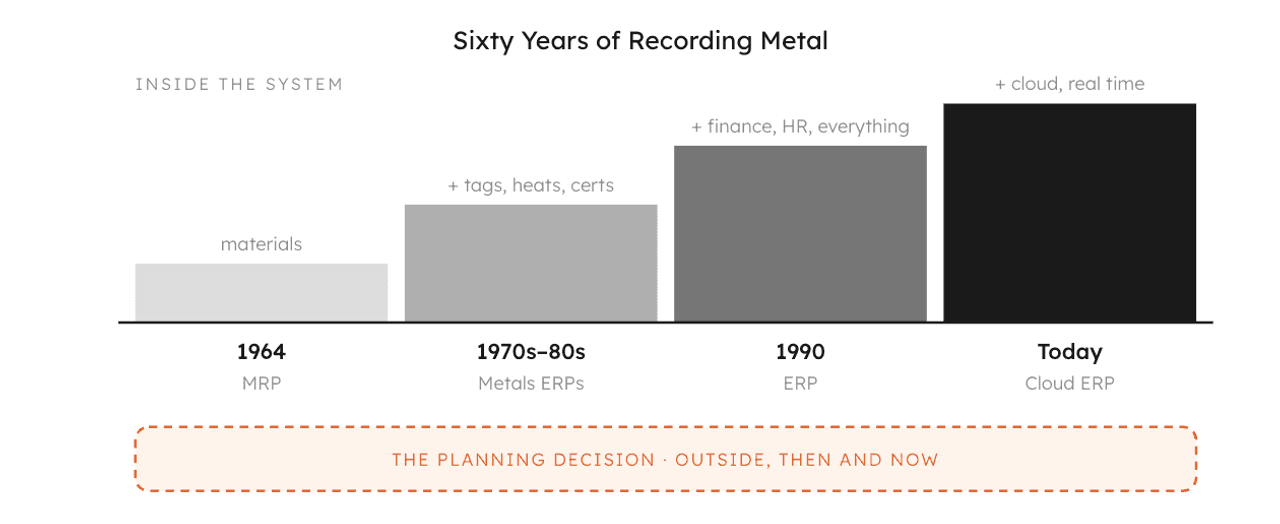
The family tree explains it. ERP descends from material requirements planning, the method Joseph Orlicky and IBM worked out in the 1960s to explode a production schedule into the materials it would consume. Generic MRP never fit metal. It was built for factories that assemble parts from a bill of materials, and its basic unit, the part number, cannot describe a master coil that exists in continuous gauges, widths, grades, and coatings, and that becomes several new products every time it is slit. So in the late 1970s and 1980s the metals industry got systems of its own: metals ERPs built around attribute coded products, tag level inventory, heat numbers, mill certs, and parent coils that become child coils. For keeping the record of a service center straight, they are genuinely better than anything generic ever was.
They are still systems of record. A metals ERP can tell you, instantly and to the pound, everything about the 300 coils on your floor: gauge, grade, width, heat, cert, age, owner. Ask it which one to open against tomorrow's order book and it has no opinion. That is not a criticism. It is the job description: an accurate account of what the business has, what it owes, and what it promised. Choosing was never in it.
Planning is a different kind of problem
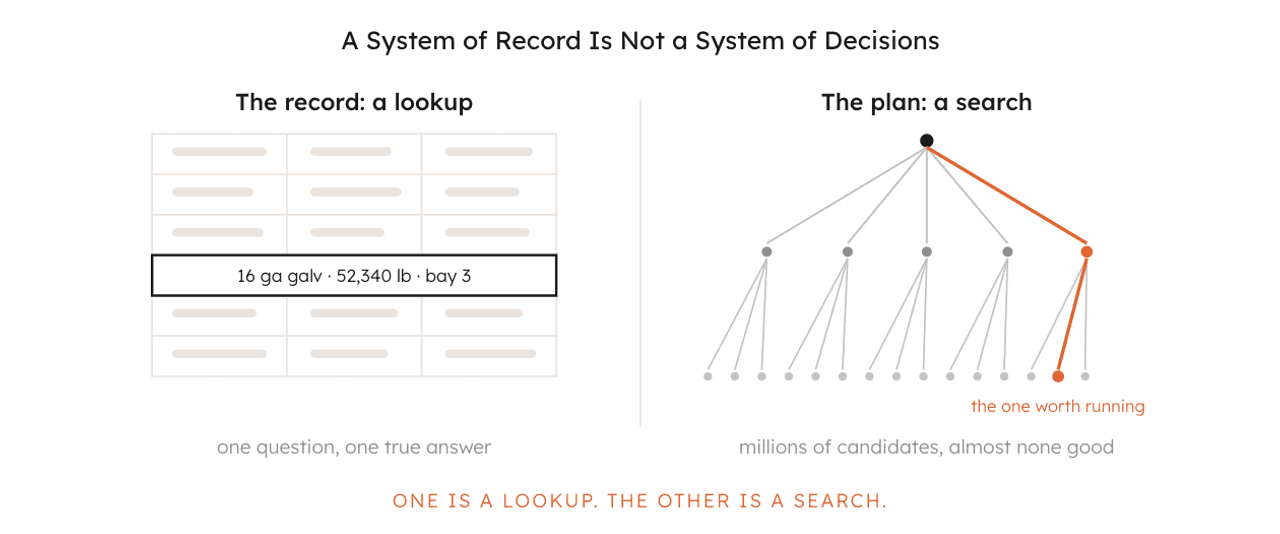
The difference is lookup versus search. A record system answers questions that have one true answer: how many tons of 16 gauge galvanized are in bay 3. Planning answers a question with millions of candidate answers, almost all of them feasible and almost none of them good: which orders get cut together, from which coils, in which sequence, through which knife setups. We have written about that problem before. It is NP-hard, the constraints interact, and the version with metal service center rules in it is one of the hardest scheduling problems in manufacturing.
ERP vendors know this, which is why planning add-ons exist. Advanced planning and scheduling modules have been bolted onto ERPs since the 1990s, and they are genuinely useful in the factories they were designed for: jobs, machines, routings, run times. A slitting floor is not that factory. A generic module has no native concept of a slit pattern, arbor space, edge trim, gauge and grade compatibility, or a max-out. Those constraints arrive as configuration, customization, and consulting hours, and Panorama's 2026 ERP report describes where that road tends to lead: misfits discovered late in the project, then scope expansion and custom builds to compensate.
The deeper problem is that customization buys the wrong thing. A custom field is still a record. You can teach an ERP to hold every knife, arbor, and gauge rule on your floor, and at the end you will own a perfect description of the problem and nothing that can solve it. The search itself, evaluating millions of candidate plans against all of those constraints at once, is a different discipline entirely. It is not on the menu at any number of consulting hours.
The spreadsheet next to the ERP
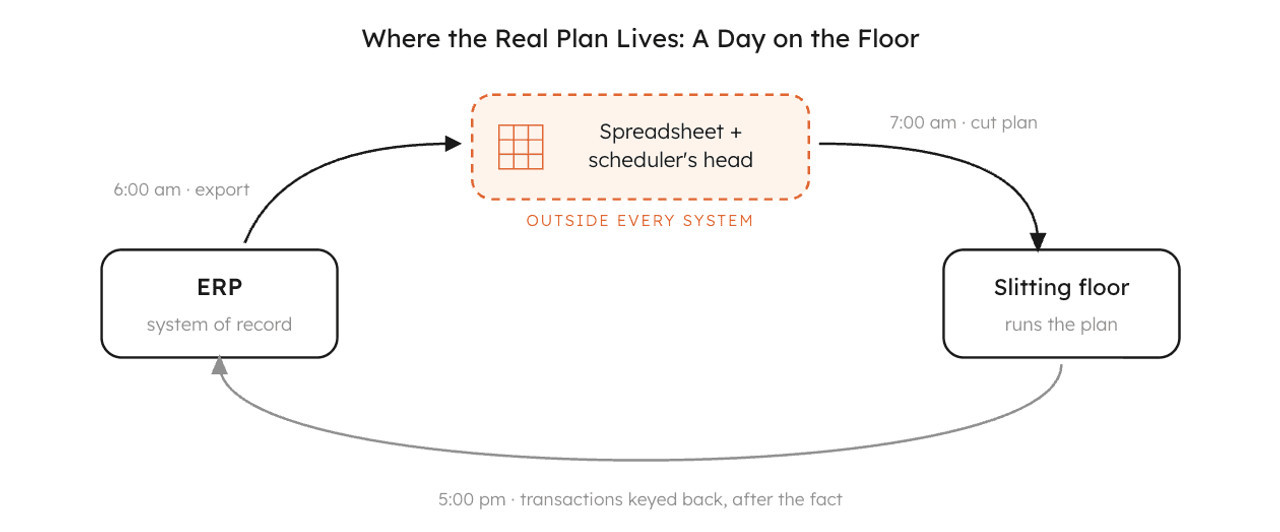
There is a simple test of whether a planning system is doing its job: where does the plan actually live? On most slitting floors the honest answer is a spreadsheet fed by an ERP export every morning, plus a scheduler who carries the real constraints in their head. The plan takes shape outside the system, gets run on the floor, and reaches the ERP afterward, as transactions recording what already happened.
Consider what that means. The decision that determines how much of every coil ships as product instead of scrap, worth over half a million dollars a year per point of scrap rate at a 50,000 ton operation with hot rolled coil at $1,105 a ton, is made with no system of record at all. No record of the alternatives that were considered. No way to learn from last month's plans. And it walks out the door when the scheduler does.
The right division of labor
None of this is an argument against your ERP. A service center needs a system of record the way it needs a scale, and the ERP is good at being one. The fix is not replacement. It is a division of labor: a layer that reads the order book and the live coil inventory out of the ERP, messy as that data usually is, runs the search the ERP was never built to run, and hands back complete plans the floor can actually execute. The ERP keeps the record. The engine makes the plan. The scheduler keeps the judgment, steering and overriding, with every override teaching the engine a little more about how the operation actually runs.
That is what LineSight AI does for coil production planning, and planning is the right place to start because it is where the math is hardest and the money is most immediate. But the pattern is bigger than one decision. A service center also decides what to buy, what to carry, what to quote, and what to promise, and today every one of those decisions follows the same loop: data out of the ERP, judgment outside the system, transactions keyed back in. Close that loop once and the others start to follow.
Your ERP has done its job for thirty years. It remembered everything. Deciding was never its job.
This piece was written by the LineSight team. LineSight builds AI powered software that automates coil production planning for metal service centers. linesight-ai.com
Sources
Joseph Orlicky. "Material Requirements Planning: The New Way of Life in Production and Inventory Management." McGraw-Hill, 1975.
F. Robert Jacobs and F. C. Weston Jr. "Enterprise Resource Planning (ERP): A Brief History." Journal of Operations Management 25, no. 2 (2007): 357-363. sciencedirect.com
Oracle NetSuite. "The History of ERP." netsuite.com/portal/resource/articles/erp/erp-history.shtml
Invera. "About Us." On the origin of attribute based product coding for metals, where part numbers failed. invera.com/about-us
Panorama Consulting Group. "The 2026 ERP Report." panorama-consulting.com/resource-center/erp-report
Hartmut Stadtler, Christoph Kilger, and Herbert Meyr, eds. "Supply Chain Management and Advanced Planning: Concepts, Models, Software, and Case Studies." 5th ed. Springer, 2015.
IndexBox. "Nucor Increases Hot-Rolled Coil Price to $1,105/Ton as of June 2026." June 2026. indexbox.io
LineSight. "The 65-Year-Old Math Problem Running Your Slitting Line." June 2026. linesight-ai.com/blog
Header photo: Charlota Blunarova via Unsplash (Unsplash License). unsplash.com