The 65-Year-Old Math Problem Running Your Slitting Line
A metal service center runs on decisions. The hardest one is made before the first coil is loaded.

LineSight
May 2, 2026

A metal service center is a decision operation as much as a processing operation. Every day someone decides which coil to buy and at what price, which to open and which to hold, which orders get cut together and how, what ships on which truck. Most of those decisions are made the way they were made forty years ago: by experienced people, under time pressure, with spreadsheets.
The most consequential of them is production planning. Which orders get cut together, and how, is decided before the first coil gets loaded, and it determines how much of every coil ships as product instead of scrap. In most shops the answer comes from an experienced scheduler and a feel for the order book that takes years to develop. What is easy to miss is that this daily routine is also one of the oldest and most studied problems in operations research, and one of the most stubbornly difficult. The textbook version has a 65-year-old solution. The version that runs on a slitting floor is another matter.
A problem older than the computer that solves it
The cutting stock problem was first formalized in 1939 by Leonid Kantorovich, a Soviet mathematician asked to help a plywood trust get more product out of the same logs. His question was simple to state and brutally hard to answer: given stock material of a fixed size and a list of required pieces, which cutting plan wastes the least? The work later earned him a Nobel Prize in economics.
In 1961, Paul Gilmore and Ralph Gomory published the paper that defined the modern version of the problem, motivated by paper mills slitting giant rolls into customer widths. Their technique, now called column generation, made it possible to find provably near optimal cutting plans without checking every possibility one by one. It was a landmark. It was also built for the clean version of the problem. The full version, the one where you cannot ship a customer 0.7 of a strip, belongs to a class of problems mathematicians call NP-hard: the work required explodes as the problem grows, and no general shortcut is known to exist. Sixty five years of research have produced better and better ways to attack it. None of them have made it easy.
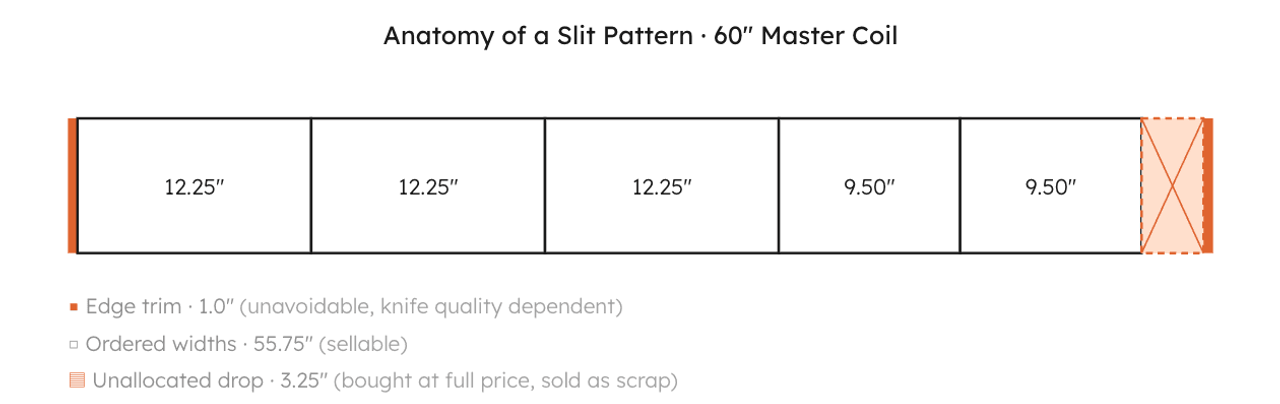
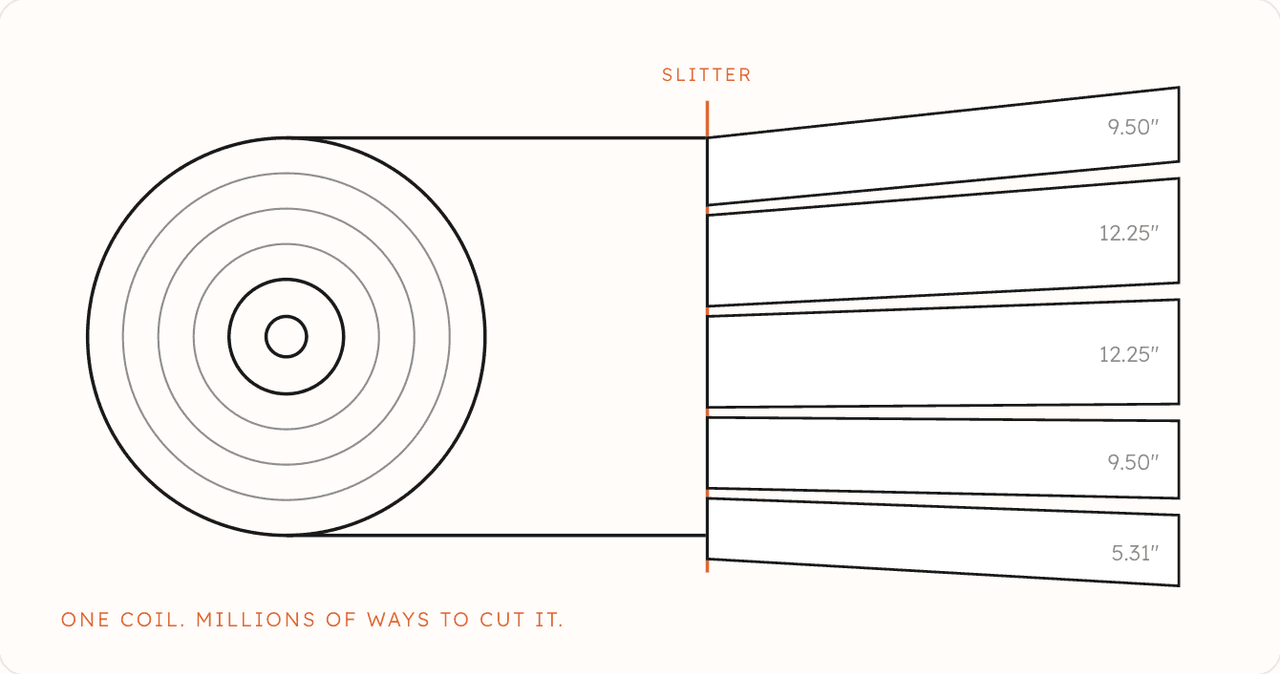
Swap paper for steel and this is exactly what a slitting line does. A master coil arrives at 60 inches. The order book wants 12.25s, 9.5s, and 5.31s in different quantities, gauges, and due dates. Every setup is a pattern. Every pattern leaves something behind. The goal is to ship as much of every coil as ordered product instead of scrap.
Dozens versus millions
So why does a problem this well studied still cost service centers money? Because the version on a real floor is bigger and meaner than the version in the textbook. A pattern is only feasible if it fits the knife and arbor setup, respects minimum and maximum strip counts, groups compatible gauges and grades, and gets the right orders onto trucks on the right days. And the constraints interact: the pattern that minimizes scrap can blow a due date, and the pattern that makes the truck can burn an extra setup. Each constraint on its own shrinks the set of patterns a scheduler can safely run. Together they turn a hard problem into one of the hardest scheduling problems in manufacturing.
The numbers get out of hand quickly. With a handful of order lines, the feasible combinations number in the dozens, and an experienced scheduler will find a good answer. With a full day's order book, they number in the millions. A human evaluates dozens of candidates before the shift starts. The gap between the dozens that get checked and the millions that exist is where scrap lives.
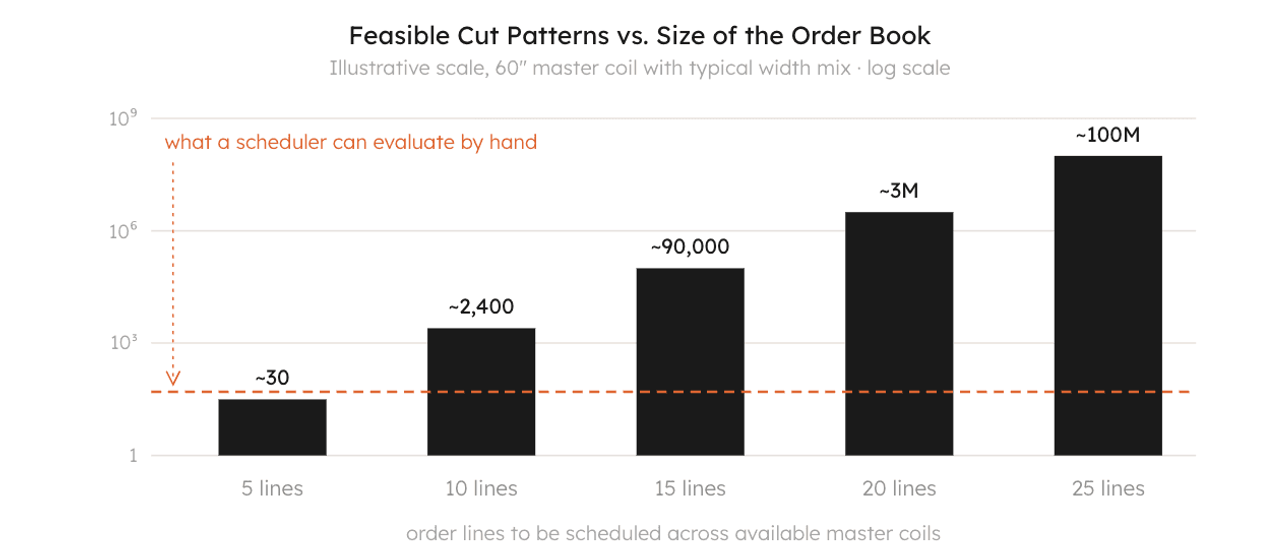
None of this is a knock on schedulers. It is a statement about arithmetic. The best scheduler in the industry cannot evaluate three million patterns before the morning shift starts, and neither can anyone else.
What a point of yield is worth in June 2026
This would all be academic if material were cheap. It is not. Nucor raised its hot rolled coil spot price to $1,105 per ton effective June 1, and service center inventories are sitting at multi year lows, which means the coil on your floor was bought at today's prices, not last year's. There is no inventory cushion to hide a yield problem behind.
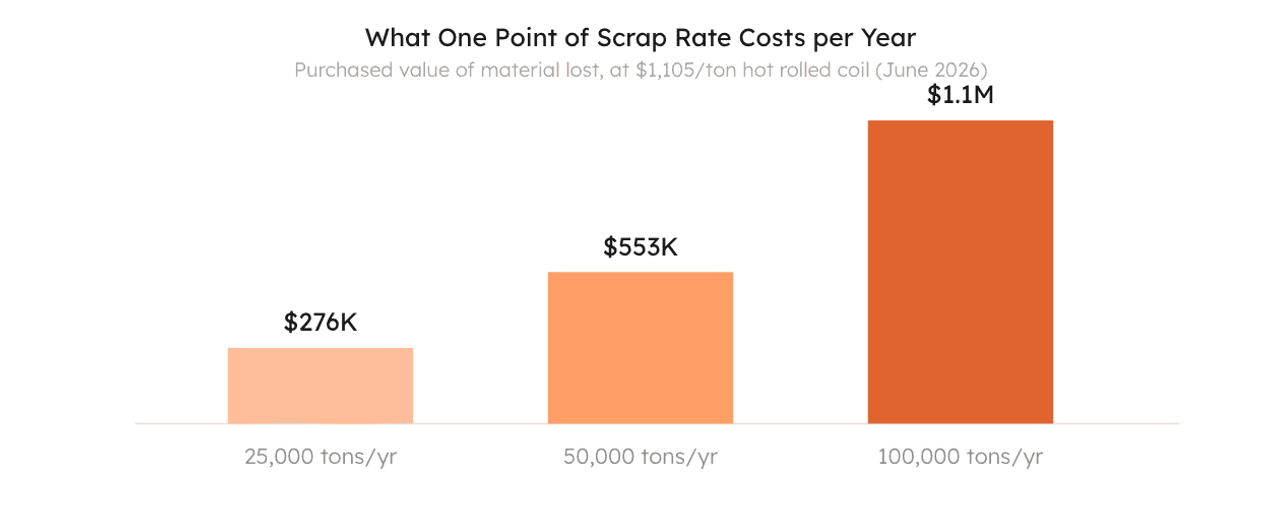
The math is blunt. At a 50,000 ton per year operation, one point of scrap rate is 500 tons of material purchased at $1,105 and recovered at scrap value. Closing a single point puts over half a million dollars of purchased material back on trucks instead of in the bin. At 100,000 tons, it clears a million. And every one of those dollars traces back to a decision made before the line started.
Automating the first decision
The good news is that the heavy end of this problem is exactly the part computers are built for. The catch is that most optimization software was not built for this version of it. Cutting stock solvers exist for paper, glass, textiles, and sheet nesting, and they are good at the problem those industries have. Point one at a slitting floor and the gaps show quickly: it does not know what a knife change costs, which gauges can run together, which coil in inventory to open first, or that the order due Thursday matters more than the one due next week. The constraints that make a metal service center a metal service center are exactly the ones a general purpose tool treats as footnotes.
This is the problem LineSight AI automates. It takes the order book, the live coil inventory, and the rules of the floor, the knife and arbor limits, the gauge and grade compatibilities, the truck schedule, and turns hours of manual planning into minutes: complete cut plans with the scrap accounted for, the due dates respected, and the reasoning visible. Not cutting stock in general. The metal service center version of it, modeled from the floor up, because bolting these constraints onto a generic solver after the fact is how plans end up optimal on paper and unrunnable on the line. It is a harder problem to build for, which is most of the reason so few have.
What stays with the scheduler is the judgment the system is still learning from: which customer can flex a day, which coil to hold back for a job that has not landed yet, when the plan that looks right on paper is wrong for a reason that lives on the floor. Today the scheduler steers and the software searches. Every override teaches the engine something about how the operation actually runs, and the plans get better for it.
Production planning is the first decision worth automating because it is the one where the math is hardest and the money is most immediate. It is not the only one. A service center also decides what to buy and when, what inventory to carry, what to quote, what to promise, what to ship, and all of those decisions lean on the same underlying question: what is this coil actually worth to this order book? Get the planning decision right, with a system that understands the whole operation, and the others start to follow.
Kantorovich wrote the problem down 87 years ago. Gilmore and Gomory cracked the textbook version 65 years ago. The version with knives, gauges, coils, and trucks in it is only now being solved properly, and most of the industry is still working it by hand. That gap is open today. It will not stay open forever.
This piece was written by the LineSight team. LineSight builds AI powered software that automates coil production planning for metal service centers. linesight-ai.com
Sources
L. V. Kantorovich. "Mathematical Methods of Organizing and Planning Production." Management Science 6, no. 4 (1960, original Russian edition 1939): 366-422.
P. C. Gilmore and R. E. Gomory. "A Linear Programming Approach to the Cutting-Stock Problem." Operations Research 9, no. 6 (1961): 849-859. pubsonline.informs.org/doi/10.1287/opre.9.6.849
P. C. Gilmore and R. E. Gomory. "A Linear Programming Approach to the Cutting Stock Problem, Part II." Operations Research 11, no. 6 (1963): 863-888. pubsonline.informs.org/doi/10.1287/opre.11.6.863
Gerhard Wascher, Heike Haussner, and Holger Schumann. "An Improved Typology of Cutting and Packing Problems." European Journal of Operational Research 183, no. 3 (2007): 1109-1130.
IndexBox. "Nucor Increases Hot-Rolled Coil Price to $1,105/Ton as of June 2026." June 2026. indexbox.io
Ryerson. "Are Steel Prices Coming Down? Latest Hot Rolled Coil News." Metal Market Intelligence, June 2026. ryerson.com
Metals Service Center Institute. Metals Activity Report, 2026. msci.org/research_data/metals-activity-reports
LineSight. "What Is a Metal Service Center and Why Does Efficiency Define the Business?" March 2026. linesight-ai.com/blog
Header photo: Morteza Mohammadi via Unsplash (Unsplash License). unsplash.com