Why a Steel PO Breaks Generic AI Order Entry
Steel POs describe material instead of naming it, price by weight on a different basis and carry tolerances. Generic AI order entry misses all three.

LineSight
September 2, 2026
Most AI order entry tools were built for a purchase order line that holds a part number, a quantity and a price. A steel PO line holds none of those in the form a generic tool expects. The material is described rather than named, the quantity is a weight that is often priced on a different basis, and the tolerances written on the line are part of what the customer is buying. A generic extractor reads all of it without complaint and gets enough of it wrong, quietly, that someone still has to check every order before it reaches the ERP.
That check is the right instinct, and it should stay. What a tool built for metal changes is how much of the work lands on the person doing it. Order entry is an early step in a long chain (from PO to release walks through all of it), and nothing downstream can start until the sales order exists. The coil cannot be matched and the slit plan cannot be built while the PO is still sitting in an inbox waiting to be typed.
A line with no part number
Take a typical line: 16 GA G90 × 4.250 in, 12,000 lbs. There is no part number in it. It is four attributes run together in a string, and each one has several legal spellings. Gauge arrives as a gauge number, a decimal or a millimeter figure. Grade arrives as a coating designation, a full spec callout, or an alloy and temper. The item master may hold the same material under none of those strings.
Metals ERPs dealt with this decades ago by coding products by attribute and tracking inventory by tag, because a part number could never describe material that comes in continuous gauges and widths. That is the right design for a service center and the wrong input for a generic extractor, which is built to find an identifier on the line and look it up. On a steel PO it finds nothing to look up, so it guesses at the nearest match or hands back the raw text, and either way a person ends up doing the mapping by hand. A tool built for metal has to parse the description into its attributes, normalize the units, and match the result against the attribute-coded item master and the coils actually on the floor.
Pounds, hundredweight and the hundredfold error
Quantity on a steel PO is usually a weight, and the price is often quoted on a different weight basis from the quantity. Lines come in pounds, tons, hundredweight, coils or skids. Prices come per hundredweight, per pound, per ton or per piece. A generic tool treats the unit as a label sitting next to the number, when on a steel order it decides what the number means.
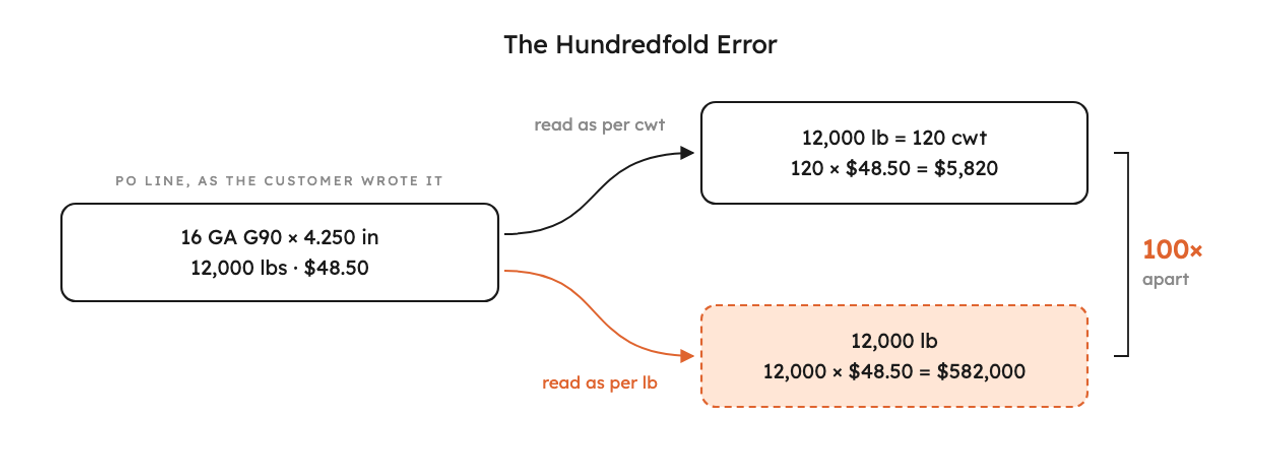
Go back to that 12,000 pound line and put a price of $48.50/cwt on it. A hundredweight is 100 pounds, so the line is 120 cwt and extends to $5,820. Read the same price as $48.50 per pound and the line comes to $582,000. That is a hundredfold error, and it gets past a quick look because the figure $48.50 seems perfectly normal sitting in a unit-price field. The extension would give it away if someone checked the extension, which is exactly the step an automated tool is supposed to have saved them.
Billing errors can be corrected with a credit memo. Physical ones are harder to undo. A strip slit to the wrong width usually ends up as scrap at full material cost, and SteelBenchmarker put US hot-rolled band at $1,173 a net ton in its 30 September 2026 report. That is roughly what each ton of a mis-slit coil costs before anyone has been paid to handle it.
Tolerances, repeats and revisions
Tolerances are part of the order. A line may carry a gauge range, a width tolerance, a minimum and maximum coil weight, a PIW window and an ID requirement, and whether a given coil can fill the line depends on those numbers. (The glossary defines each of them.) An extractor whose schema has no field for a tolerance simply drops it, which turns a flexible order into a rigid one. Nobody notices until the plan comes back short of coils that would have qualified.
Repeated lines cause the opposite problem. A steel PO often lists the same gauge and coating at four different widths, the same width across three due dates, or a release against a blanket order. To a generic tool, lines that look nearly identical suggest duplication, and merging them is a sensible default for most business documents. On a steel PO it deletes real demand.
Then there are the sources. A clean PDF is the easy case. Orders also arrive as scanned faxes, Excel attachments, phone photos of a printed PO, three lines typed into the body of an email, or a WhatsApp message from a buyer who has a salesperson's cell number. Two hours later a revision may follow asking to ignore line 3. A system that reads the revision as a fresh order has created a second sales order and made the morning worse, so order entry for metal has to recognize when one message changes another.
A person signs before anything commits
None of this argues for software that writes into the ERP unattended, and anyone selling that deserves some skepticism. The arrangement that holds up splits the work. The software watches the inbox, reads the order, cross-checks it against the item master, live inventory and the customer's credit, and drafts the sales order. A person approves it before anything commits. When the software is unsure (a description matches nothing, a width exceeds the master coil, a price disagrees with the quote) the order goes to a person with the source document beside the extracted fields, so the check takes seconds and nobody retypes anything.
Accuracy claims deserve the same caution. How well a system extracts depends heavily on how it is built around the model, so a vendor's own benchmark says little about your mail. One 2026 study of invoice extraction found the same general-purpose models scoring 78 to 83% F1 with naive prompting and 96 to 98% once the extraction was engineered properly. The numbers worth asking for are measured on your own orders: how many went in untouched, how many needed one field fixed, and how many errors were caught at review before they reached the floor.
The speed matters because of what is waiting behind it. Once the order is in, the lines can be matched to coils, the slit plan built, short material bought and the freight booked. A plan built at 8 a.m. against the full order book will beat one rushed at 4 p.m. against whatever had been typed in by then.
LineSight AI's Command Center works this way. It reads POs from email, PDF, photo, text and WhatsApp, enters the sales orders into the ERP, and carries on into the purchase orders, outside processing POs and work orders that follow, with each entry approved by someone on the team before it stands. That whole-chain version is what we mean by a command center, and order entry is the step at the front of it that everything else waits on.