What Is a Command Center for Metal Processing?
Service centers own software that records what they have and almost none that runs what they do. A command center is software built for the second job.

LineSight
September 2, 2026

Every metal service center owns software that knows what it has. The ERP can tell you, to the pound, what is sitting in bay 3 and which heat it came from. Almost none own software that runs what they do. A command center for metal processing is software built for that second job. It takes an order from the moment the PO lands to the moment the truck is released: entering it in the ERP, matching material, building the slitting plan, issuing work orders, booking freight and buying whatever inventory cannot cover, with a person approving the decisions that carry judgment or money.
The category is new enough to lack a settled name. The work it describes is old, done every day at every service center by people at desks, and most of it is retyping.
The desk at seven in the morning
Look at an order desk at 7 AM. The ERP is open to order entry. Next to it sits a spreadsheet the planner built himself, an inbox with forty-seven unread messages (some of them POs as PDF attachments) and a phone holding a customer's photo of a handwritten order. Around the monitor are sticky notes, because the ERP has no field for call the customer back about the truck before 2 PM.
A purchase order arrives as a PDF and someone retypes its four lines into order entry. Line three throws a width error and gets entered again. The planner pulls the order book and coil inventory into his spreadsheet and nests widths by hand, three at 4.250 and two at 6.000 out of a sixty-inch master, then fills the rest and works out the scrap. It comes to eight percent, so he tries five-inch multiples, finds there is no stock to cut them from, and starts over. The resulting work orders get typed a second time and emailed to the floor, then emailed again to the toll processor. Someone calls three carriers, writes three numbers on a pad, picks one and types the release. Whatever inventory did not cover becomes a note to purchasing, and eventually an RFQ.
Every step on that desk is either a transcription or a search. The transcription is beneath the person doing it. The search, meaning which orders go on which coils in which sequence, is beyond what any person can do properly, because with a full day's order book the feasible combinations run into the millions and a morning allows for dozens. So the desk does the easy half slowly and the hard half approximately, and the scrap rate absorbs the difference.
Software that records and software that runs
The ERP is doing its job in that picture. It is a system of record, and a good one: it remembers everything and decides nothing, which is what an ERP is for. Ask a metals ERP what is on the floor and it answers to the pound. Ask it which coil to open against tomorrow's book and it has no opinion. Everything on that desk at 7 AM lives in the space between the record and the floor, and at most service centers only people fill it.
A command center sits in that space. It watches the channels orders actually arrive on, from email and PDFs to photos of a marked-up sheet, and enters each sales order through the ERP's own screens with the customer's own codes. It holds the whole order book against live inventory, searches for the plan that ships the most material at the most profit, and flags what stock cannot cover. It creates the work orders and sends them out, to your slitters and to the outside processors that usually get forgotten. It collects freight quotes, books the carrier you pick and sends the release. Whatever is still open after allocation becomes a buy, sourced and sent out for quote, and the replies come back to the same board.
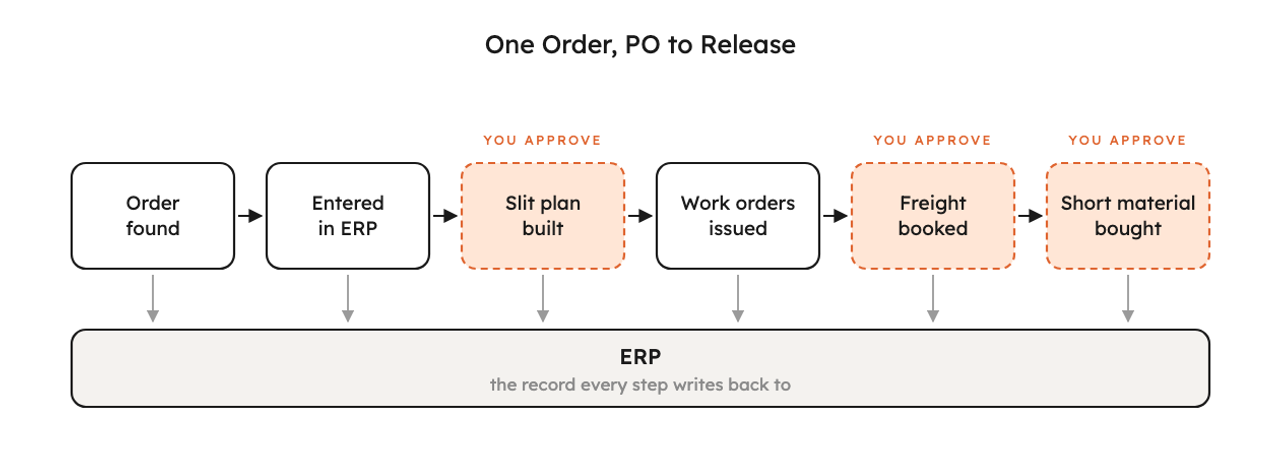
None of those steps is new on its own. What makes the whole thing a command center is that they run as one chain with nobody retyping between them, and each decision is written back into the ERP so the record stays complete. From PO to release follows the same chain from the operator's side of the desk.
Why the pieces you already own do not join up
Most service centers have already been sold part of this. Advanced planning modules have been bolted onto ERPs since the 1990s, and they were built for factories with parts, routings and run times. A slitting floor's primary objects are patterns, arbor space, edge trim, knife setups and max-outs, and in a generic module those arrive as configuration and consulting hours. A custom field is still a record. You end up owning a perfect description of the problem and nothing that solves it.
Standalone cutting-stock optimizers have the opposite gap. They are real and good, and pointed at a slitting floor they will hand you a pattern. They do not know what a knife change costs, and they will not enter the order, tell the toll processor or book the truck. They answer one question in the middle of the chain and leave the rest of the desk exactly where it was.
General AI assistants connected to inventory data answer questions well, but they wait to be asked, and they carry no model of the floor. None of them knows that 0.7 of a strip cannot ship, or that two gauges cannot run on the same setup. A command center has to carry that model, because grades, gauges, slit widths, ID and OD, PIW, edge conditioning, multi-pass work, coil weights, toll processing, minimum and maximum multiples and the capabilities of each individual slitter all bear on whether a plan can actually run. Miss one and a plan that looks fine on paper becomes one the floor quietly ignores.
Where the person stays
A command center that decided everything would not survive a week on a real floor. The working arrangement is a board with three columns: needs you, in progress, done. Work lands in the first column when the decision carries judgment or money. The slit plan waits for approval before it goes to the floor. When three freight quotes are in, a person picks the carrier. A mill quote on a buy gets accepted or turned down by someone who knows the mill, and when a PO leaves a header field blank, someone who knows the customer fills it.
Everything else runs, and the day changes shape. What used to be eight hours of transcription wrapped around one hour of judgment becomes the hour of judgment, spent on a queue that is already staged with the alternatives visible. The software does the search and the typing. The person keeps the call on which customer can flex a day and which coil to hold back for a job that has not landed yet, and each of those overrides becomes a worked example the system keeps.
Running what you do
LineSight AI builds a command center for metal processing. It starts from the slitting plan, where the math is hardest and the money most immediate, and runs the chain on either side of it. Elite Steel added $850K in annualized revenue and cut its scrap rate 2.9 points after going live.
The ERP will keep doing what it does well, which is remember. At most service centers the running of the business still happens at that desk at 7 AM, by people whose judgment is worth far more than their typing. Software has spent decades recording what service centers have. The next stretch of it will run what they do.