How to Reduce Scrap on a Slitting Line
Slitting scrap is decided twice, at the machine and in the plan. Practical fixes for clearance, trim and tension, then for patterns and coil choice.

LineSight
September 2, 2026

Scrap on a slitting line is decided twice: at the machine, and earlier, in the plan that says which orders get cut together, from which coil, in what sequence. Reducing it means working both. At the machine, set knife clearance and edge trim for the material actually on the arbor, keep tooling true and control tension. In the plan, build patterns across the whole order book, pick the coil that fits the pattern, use the tolerance customers have already given you, and measure scrap by where it comes from.
Most published advice stops at the first half. That advice is sound, and the machine is the right place to begin. But the second decision usually moves more tonnage, and it gets far less attention, partly because the people who write about slitting tend to sell slitters. If any of the vocabulary is unfamiliar, the metal service center glossary defines it.
What the machine decides
Set knife clearance from the thickness and the tensile strength of the coil being run, rather than one number for the whole shop. Clearance is the horizontal gap between upper and lower knives, expressed as a percentage of material thickness, and the old rule of 10 percent is rarely correct. Per The Fabricator, suggested clearance for low-carbon steel alone runs from 10 to 26 percent. Too tight and the knife throws a burr; too loose and the metal tears, leaving slivers, edge ripple and rolled edges on material you have already paid to process.
The check is burr height as a percentage of thickness, measured on the first piece and logged by setup. Kloeckner Metals puts the industry norm at 10 percent, and tighter operations aim for 5. A rising burr is usually the earliest sign that clearance or tooling has drifted, well before an edge looks wrong to the eye.
Gauge and log spacer stacks instead of eyeballing them, track knife life by footage, and check arbor runout on a schedule. Tooling error shows up as inconsistent width and edge quality across the mult, and one bad knife position can reject a strip while the other nine run fine. Heavier, higher-tensile material deflects the arbor more, so a setup that holds at 0.030 inch may not hold at 0.100. Look at width variation by knife position: if the same position keeps turning up as the outlier, the cause is in the tooling and retraining the operator will not fix it.
Trim what the coil edge and camber require, and revisit any standing trim allowance that was set years ago. Edge trim is the largest planned loss on most lines and the easiest to overspend, because an extra eighth of an inch per side is paid for on every coil that runs. How much you need to take depends on what you received. Mill edge carries width variation on the order of ±0.125 inch, against ±0.005 inch for a slit edge, per EOXS, so a coil that arrives slit-edge should not be trimmed like one straight from the mill. Track trim as a share of master width. On a 60-inch coil, a quarter inch per side is 0.83 percent of the coil, and half an inch per side is 1.67 percent.
Set strip tension per gauge and grade, and watch the outer strips on wide patterns, which travel a different path length and tend to show a defect first. Loose or uneven tension through the separator and recoiler produces telescoping and camber, and coils the customer will send back. Too much tension marks the surface and stretches thin gauge. Count rejects for coil condition separately from rejects for width; lumped together, they send you chasing the wrong fix.
What the plan decides
Build patterns from the whole compatible order book at once, instead of one order or one customer at a time. This is the largest single lever on most slitting floors, and it is usually pulled by one person under time pressure. Take a 60-inch master with a quarter inch trimmed from each side, which leaves 59.5 usable inches. Four 12.25-inch strips use 49 of them and leave 10.5 inches in the bin, an 18.3 percent loss once trim is counted. Add a 9.5-inch strip from another order and the drop falls to one inch, for total scrap of 2.5 percent.
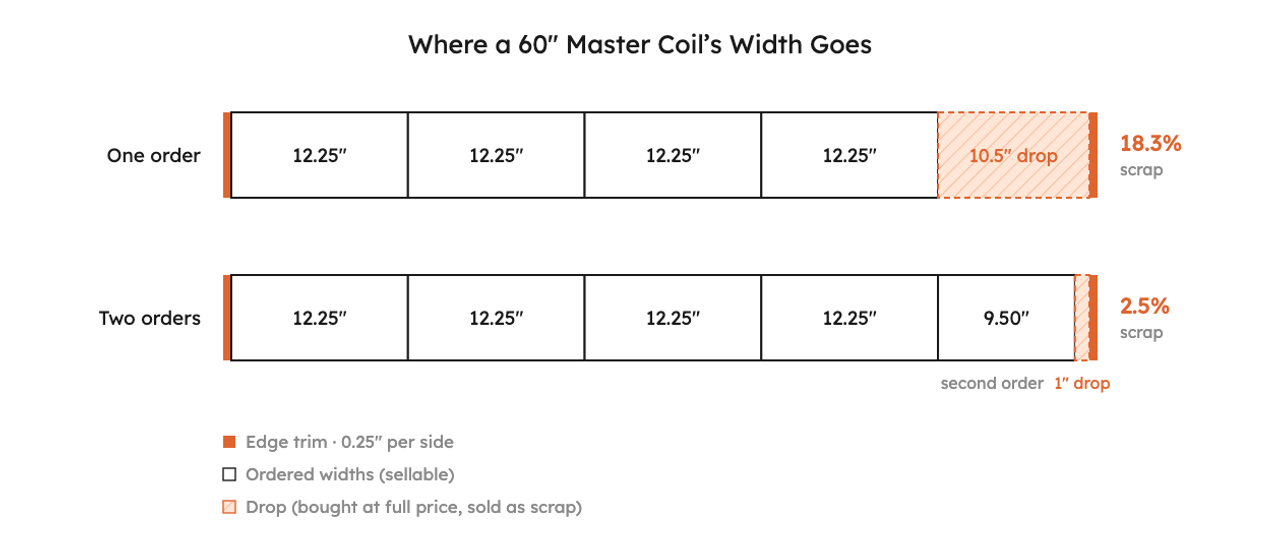
The strip that closes the drop is rarely on the same order as the 12.25s, and often belongs to a different customer. What limits a pattern is metallurgical and dimensional (grade, gauge, coating, width and PIW), and the name on the order has no bearing on any of it. Track yield per pattern, as shipped pounds over coil pounds, since a monthly figure lets good setups and bad ones average each other out. It is also worth counting how many patterns serve more than one customer. A low share usually means the order book is being planned in silos.
Evaluate an order set against every compatible coil on the floor before opening one. Two coils of the same grade and gauge can differ by several points of yield on the same orders purely because of width, and opening whichever coil is nearest the door has a price. The same logic reaches back into purchasing: buy widths that nest with your repeat order book, which may not be the widths that look standard. A wide yield spread across coils used for the same order group is the sign that coils are being chosen by convenience.
Carry the real minimum and maximum gauge and width through planning. Most orders specify a range, and planning to the nominal value throws away every pattern that would have worked at the edge of tolerance, along with coils the customer would have taken. A 0.058-inch coil satisfies a 0.055 to 0.062 inch order, and it is inventory you can use today. Keep a count of orders marked incompatible where the stated tolerance would have allowed the coil.
Group patterns that share a knife arrangement so they run back to back, and weigh each changeover saved against the yield given up to save it. Every changeover costs setup time plus material at the head of the run while the setup is proved out. Sometimes the pattern that avoids a changeover costs more in drop than the changeover would have, and that trade is better settled with numbers than by feel. Knife changes per shift, multiplied by setup scrap per changeover, gives the cost of a fragmented schedule.
Flag only the orders that are genuinely bound to a date as must-ship, and let the rest serve as optional filler the planner can pull in to close a drop. If everything is mandatory, the plan has no room to move and runs poor patterns to hit dates. Optional orders are what turn a 10-inch remnant into a shipped strip. Once more than half the order book carries the flag, it stops telling the planner anything.
Decide what happens to the remnant at plan time. A coil parked to be used later that ages out of spec was scrapped the day it was created; the paperwork simply arrived late. Either the leftover has a named home in the order book or the pattern was wrong. Partial coverage deserves the same care: ship short now or hold the coil for a full run, and make that choice on purpose. Trend the pounds of remnant and secondary stock older than 90 days.
Splitting the bin four ways
Before fixing anything, tag every scrap transaction for 60 days as edge trim, head and tail, width reject or remnant, then go after the largest bucket first. A single monthly scrap percentage says there is a problem and nothing about where it is, and the four buckets have different owners and different fixes. Head and tail is easy to underestimate. The Fabricator notes that the first and last 20 feet or so of a coil is often thrown away, off-gauge or with ends that are not square. A 40,000 lb coil at 60 inches by 0.060 inch is roughly 3,300 feet long, so those 40 feet come to about 1.2 percent of it.
How low can the total go? There is no credible published average for slitting scrap, because it depends so heavily on the order book, the width mix and the edge condition of incoming coil. A shop with four repeat widths will beat a shop with ninety on the same line. The textbook form of the cutting stock problem, with identical master rolls, gets close to perfect: the worked paper-mill example lands at 0.401 percent waste. A service center never gets there, since its coils differ in width, gauge, grade and length and its orders carry due dates. Still, it shows the direction, and most of the distance between a typical floor and that number is pattern choice. EOXS notes that even a 1 percent gain in yield can be worth six figures a year to a high-volume service center. Run that with your own tonnage and your own cost per ton.
The machine half is maintenance discipline, and most shops can do it with the people they already have. The planning half is where the arithmetic gets away from a person. Cutting stock is NP-hard, and the feasible patterns multiply quickly as the order book grows, before arbor space, minimum and maximum mults and due dates are even added. That search is what LineSight AI was built to run: it reads orders and live coil inventory from the ERP and returns complete cut plans, with the scheduler keeping the final say. Elite Steel added $850K in annualized revenue and cut its scrap rate 2.9 points after going live. That is one operation with its own mix, but it gives a sense of how much sits in the plan. For the questions worth asking when comparing tools, see the buyer's guide.