Choosing Coil Slitting Optimization Software
What coil slitting optimization software does, how it differs from your ERP, which questions to ask vendors, and how to run a fair pilot.

LineSight
September 2, 2026
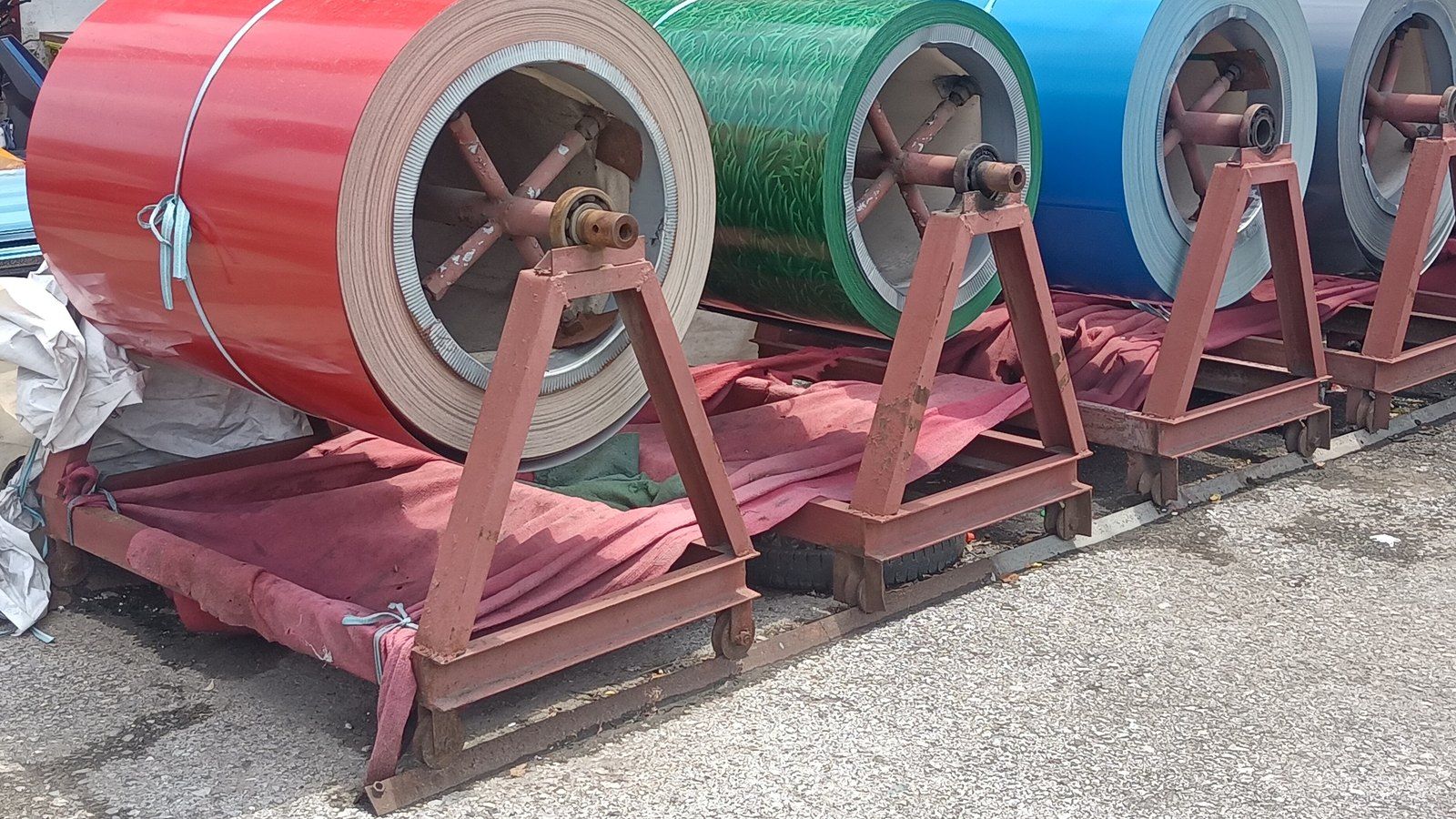
Coil slitting optimization software decides which customer orders to cut from which master coils, and with what knife arrangement. It reads the open order book and the coil inventory, searches for the combinations that leave the least trim and need the fewest setups, and hands back a slitting schedule the floor can run, with gauge, grade, width tolerance, PIW, coil weight and due dates respected. If you are shopping for it, most of what you will find online is old. The most-cited general-audience piece, The Fabricator's article on coil optimization software, was published in 2007. The math has held up since then. Nearly everything around it has moved: where the order data lives, how much a solver can work through in a minute, and how many jobs a planner is expected to handle in a day.
Old math, real constraints
Take an order book with 300 open line items and an inventory of 400 master coils. Any one coil could in principle serve dozens of those orders, and every pairing implies a different arbor layout, a different amount of trim, a different number of knife changes and a different amount of revenue booked this week instead of next. That is the one-dimensional cutting-stock problem. Gilmore and Gomory published the linear programming approach with delayed column generation in 1961, and the best methods today still build on it. It is also genuinely hard. The pricing subproblem inside column generation is itself NP-hard, and it gets worse as the variety of widths and demands grows.
A good planner handles this well and still leaves money on the table. A person can keep five or six coils in mind at once, and the best combination is often the one involving a coil nobody was looking at, paired with an order that was not due for three weeks.
Real slitting is also messier than the textbook version. Gauge and grade have to match. Width tolerance is set per customer. There is a maximum knife count, a minimum strip width, PIW and coil weight limits on each strip, arbor and separator availability, and a slitter that only takes certain outside diameters. The objective is messier too. A 98% yield plan that misses a truck is worse than a 95% yield plan that ships, so trim loss is only one of the numbers that matter; due dates, knife changes and shipped tons are the ones that show up in the P&L. The separate guide on reducing scrap on a slitting line works through those levers one at a time.
What the ERP already covers
Your ERP knows the order book, the inventory, the tags and the genealogy, and it keeps an accurate record of what happened. Metals-specific systems go further into processing. Metalware from Paragon serves flat-roll, specialty metals, toll processors and fabricators, and the metals vertical at Jonas Software grew out of long-established service-center systems. Platforms like these let a planner build a slitting job, specify the arbor layout, record slit weights and run toll work.
The operative word there is "let". The system stores the layout the planner typed in. It does not go looking for a better one. Finding a better one is a search problem, and search is the piece an optimizer adds.
Four ways shops plan today
Most service centers plan with a spreadsheet and experience. It costs nothing, and a senior planner with fifteen years on the line produces good plans with it. The limits are ceiling and continuity. One person can compare only a handful of coils per order, and the method leaves the building when they retire.
The second option is the processing module in an ERP you already own. It has your data and it produces real work orders, but it generally will not search for a better plan on its own. It suits a shop whose real bottleneck is paperwork.
The third is a standalone optimizer, purpose-built cutting-stock software. Coil Cut Optimizer from Fast-Square is one of the longer-running examples, described as software that "helps human programmers generate Optimized Cutting Patterns for Slitting and Cut-To-Length machines, minimizing Trim-Loss (Scrap) and Set-up time," while respecting order requirements such as minimum and maximum strip OD and weight, and machine limits such as maximum knife count and minimum strip width (Franz Inc case study). Tools in this group are strong on the math. The cost usually shows up at the edges, because someone has to feed them the order book and inventory and then carry the answer back into the ERP.
The fourth and newest is a command-center platform, which wraps an optimizer in the plumbing around it. Orders and inventory come out of the ERP automatically, the planner edits the plan, and work orders go back in. The bet behind this group is that the integration is the harder half of the job. These platforms tend to cost more than a standalone tool and take more manual work off the planner's desk.
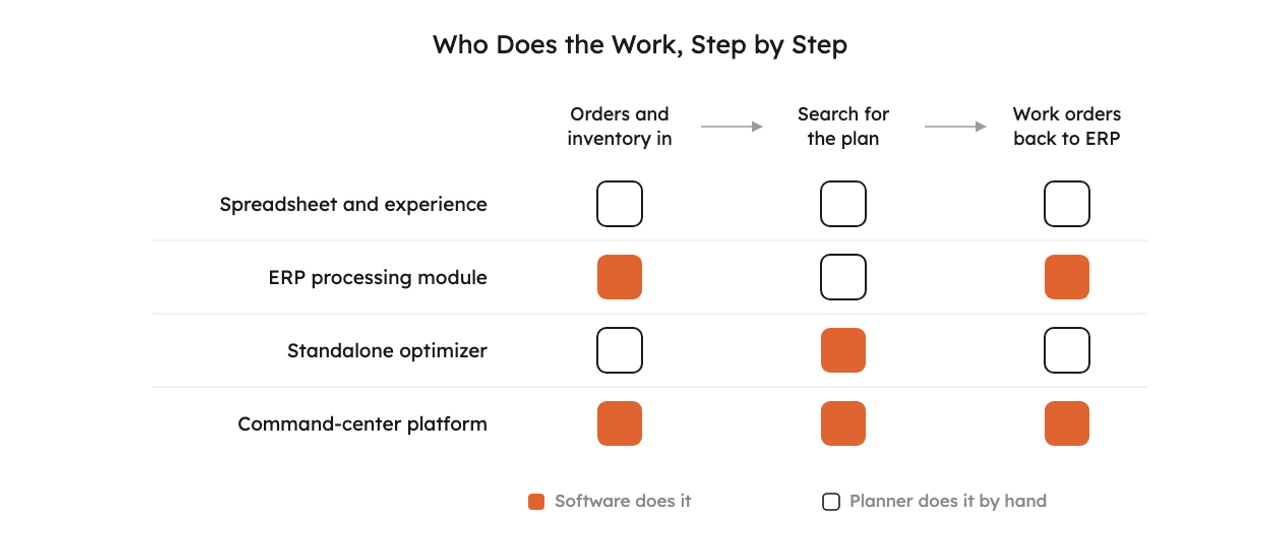
None of the four is right for everyone. If yield already sits around 96% and your planners are drowning in transcription, an ERP module or a platform will do more for you than a standalone optimizer. If you have one line, one planner and a disciplined spreadsheet habit, the spreadsheet may still be the best use of your attention this year.
Questions worth asking a vendor
Ask these with your own order book loaded. If some of the constraint names are unfamiliar to whoever is running the evaluation, the metal service center glossary covers them.
- How does it get our orders and inventory? Ask who maintains that connection when the ERP is patched, and what happens if your ERP is a 20-year-old on-premise system with no API.
- Which of our constraints does it enforce, and which does it ignore? Read out your list (per-customer width tolerance, knife count, minimum strip width, PIW, coil weight, OD limits, separators, re-slits, toll work, dedicated coils), because every "future release" is a correction your planner will make by hand.
- How long does a solve take on 300 orders and 400 coils? Under a minute is workable, while twenty minutes means nobody re-runs it after a change and the plan is stale by Wednesday.
- If a planner swaps a coil, forces an order onto a tag or drops a strip, does the tool re-cost the plan? If it accepts the edit silently, nobody knows what the change cost.
- What does the slitter operator actually work from? Ask to see the work order, knife positions and spacer stack it produces.
- What happens when the must-ship orders alone cannot all be covered? A tool that returns nothing, with no explanation, tends to be abandoned in the second week.
- How is it priced, and what will the renewal cost? Whether it is per user, per line, per site, per ton or against measured savings, get the renewal figure in writing before the pilot starts.
- When a planner overrides the plan, does the system learn the rule behind the correction? If it does not, your planner will make the same fix every week.
A 30-day pilot you can defend
The point of a pilot is to produce one number your owner believes. Pick one line and one product family, and pull the last 90 days of real slitting jobs from the ERP: master coil widths and weights, the orders assigned to each, trim scrapped and knife changes per shift. That is the baseline, and it should come from records.
In the first week, run the software in shadow on the same order book your planner is working, but ship the planner's plan. Compare the two on trim, knife changes and covered tons. Expect the software to lose on some of these, and write down exactly why. The cause is almost always a constraint nobody had put on paper.
Spend the second week encoding those constraints. This is the real work of any implementation: the width tolerance that applies to one customer, the coil nobody touches because it is allocated, the slitter that cannot run under 0.020". Feed them in and re-run the first week's book. If the vendor cannot express a rule you consider basic, you have learned something important cheaply.
In weeks three and four, run live on the pilot line, with the planner reviewing and editing every plan before release. Track trim loss percentage, knife changes per shift and planner minutes per plan, along with every override and the reason for it. By day 30 you should have a per-line change in yield and hours, a list of constraints the tool could not express, and an override count. If overrides fall over the month, the tool is learning your floor. If they hold steady, you are about to buy something your planner will fight every week.
Be wary of a pilot that ran in a quiet month, on your cleanest product family, or with the vendor driving the software. Each of those flatters the result.
We build in the fourth group at LineSight AI, and the result we point to is Elite Steel, which added $850K in annualized revenue and cut its scrap rate 2.9 points after going live. That is one operation with one product mix, which is the reason to put your own 90 days through a pilot like the one above before trusting anyone's case study, ours included. The plainer test, a month in, is whether the morning argument about which coil to run has stopped.