How Much Is One Point of Slitting Scrap Worth?
At 50,000 tons a year, one point of slitting scrap is 500 tons of steel bought at full price and sold back as scrap. How an owner can price it in dollars.

LineSight
October 6, 2026
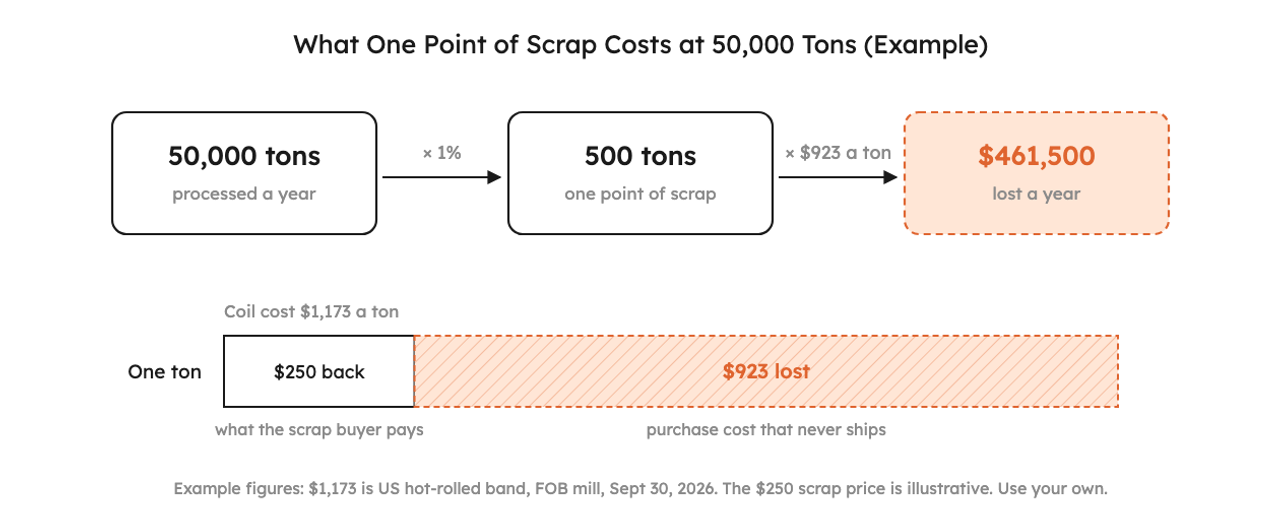
One point of slitting scrap is worth 1% of the tons you process, multiplied by the gap between what you paid for a ton of coil and what your scrap buyer pays you for it. At 50,000 tons a year, a point is 500 tons. With coil costing over a thousand dollars a ton and scrap bringing back a fraction of that, one point is usually worth several hundred thousand dollars a year, and nearly all of it comes off gross margin.
Most owners see scrap as a single percentage on the monthly report, and the percentage is easy to live with because it looks small. The tonnage behind it is the number worth looking at, and the arithmetic takes about a minute.
The arithmetic of a point
You need three figures, and your accounting system already has them: tons run through the slitters last year, your average coil cost per ton, and what your scrap buyer actually paid per ton for trim, drop and offal. The value of one point is tons processed, times 1%, times the difference between the last two.
For scale, US hot-rolled band was quoted at $1,173 per net ton, FOB the mill, on September 30, 2026 in SteelBenchmarker report #491. Your delivered cost is likely higher once freight is in, and higher again for cold-rolled or coated product. Say your average coil cost sits at that $1,173 and your scrap buyer pays $250 a ton. Each scrapped ton then loses $923. Multiply by 500 tons and one point of scrap costs $461,500 a year. At 100,000 tons, it is $923,000.
Those are example numbers, and yours will differ, sometimes by a lot. Scrap prices move from month to month and depend on grade and on what your buyer will take. The scrap calculator runs the same formula on your own cost and recovery figures, which is the version worth bringing to a board meeting.
Why scrap cuts deeper into margin than it looks
A service center earns its margin on the spread between what it pays for metal and what it sells it for, less the cost of processing. Scrap does not shave that spread evenly across every ton. It takes the whole purchase cost on the tons it touches. You bought them at mill price, paid freight to bring them in, paid for line time and knives to cut them, and then sold them back at scrap value.
Put that next to what a good ton earns. Say you clear $200 a ton in gross profit on what ships, a round figure for illustration. In the example above, one scrapped ton loses $923, enough to wipe out the margin on more than four good tons. That ratio is why a point or two of scrap moves gross margin far more than the percentage suggests. It is also why the steel you stop scrapping is so valuable: it ships against orders you already have, cut from coil you already bought.
Where the points hide
Scrap gets decided twice. Once at the slitter, through knife clearance, tooling, tension and edge trim, and once before the coil is ever loaded, in the plan that decides which orders get cut together from which master coil. On most floors the plan moves more tonnage.
Take a 60-inch master coil with a quarter inch of edge trim on each side, which leaves 59.5 usable inches. Four 12.25-inch strips use 49 of them and leave 10.5 inches of drop. Add a 9.5-inch strip from another customer's order and the drop falls to 1 inch. The coil, the line and the crew are the same. The only change is which orders the plan put together, and it recovers 9.5 inches of a 60-inch coil for the full length of the run. Our guide to reducing slitting scrap goes through the other levers, on the machine and in planning.
Three more sources rarely show up where an owner would look for them. Remnants come first: a leftover coil set aside for later that ages out of spec was really scrapped the day it was cut, though the loss lands on the report months afterward. Aging inventory is the second, coil bought for a job that changed, holding cash on the floor until it sells at a discount. The third is the mis-slit strip, where an error in order entry, a wrong width or a wrong gauge, survives all the way to the slitter and produces a strip that fits no order. Each of them was bought at full coil price, and few of them appear in the slitter scrap figure.
What to ask for before you approve spend
Whether the request is a new slitter, another planner or software, ask operations for a few numbers first. Start with scrap broken down by category for the last 90 days: edge trim, head and tail, width rejects, drop and remnants. A single monthly percentage tells you there is a problem without telling you where it is. Then ask for the tonnage of remnant and secondary stock older than 90 days, and the value it carries on the books.
After that, ask how the daily plan gets built: who builds it, in what tool, how long it takes, and roughly how many combinations of coils and orders get considered. Then ask what happens to the plan when that person is on vacation. Good planners carry a great deal of the operation in their heads, which is a real strength of the team and a real exposure for the business when nobody else can do the job the same way.
If those numbers are hard to produce, that is a finding in its own right. A team that can split scrap by cause can tell you which fix pays, and a capital request that cannot point at a category is mostly a guess.
Checking a fix on your own orders
The honest way to value any scrap fix is to measure it against your own baseline. Pick a period, record the scrap rate by category, then run the new method on the same kind of order book and compare. Anything less applies someone else's number to your mix.
Results from other shops tell you how big the lever can be. Elite Steel cut its scrap rate by 2.9 points after going live with LineSight AI, added $850K in annualized revenue and reports a 20% increase in gross margin. Points matter here: a 2.9-point drop takes a scrap rate from, say, 8% to 5.1%, where a 2.9% drop would only take it to about 7.8%. Your order mix is different, so read that result as a sign of how much planning can move and still measure your own.
LineSight builds slitting plans from open orders and live coil inventory in seconds, shows what is cut from which coil and why, and has a person approve every plan before it reaches the floor. It is live with PS Data, INVEX and Enmark ERPs and connects to virtually any other. If you want to see what a point is worth on your own order book, book a demo; the first three months are free.