Metal Service Center ERPs Compared: Eniteo, INVEX, Metalware, Steel Manager III
Who makes the main metals ERPs, what each is known for, and where slitting planning fits once the system of record is in place.

LineSight
September 2, 2026
There is no single best ERP for a metal service center. The established metals-specific systems are Eniteo from Enmark Systems, INVEX from Invera, Metalware from Paragon Consulting Services, Steel Manager III from 4GL Solutions, and SSCS from P.S. Data Services. All of them keep the record of a service center well, from tag-level inventory and coil genealogy to certs, work orders and invoicing. The right one depends on your product mix, how many sites you run, and how you want the system hosted.
No vendor in this market publishes a comparison, so each description here comes from the vendor's own material or the trade press, linked where the claim is made. None of them publishes pricing.
Why metal needed its own ERP
Generic ERP never fit this industry. Its basic unit is the part number, and a master coil does not have one. It exists in continuous gauges, widths, grades and coatings, and it becomes several new products the moment it is slit. So metals got its own category of software, built around attribute-coded products, several units of measure on one order line, and tag-level inventory in which every coil, drop and remnant is tracked on its own. Genealogy carries heat numbers and mill certs from a parent coil to every child cut from it, and work orders cover toll work on material you never own. The glossary defines the terms.
Paul Parsons, VP of sales and marketing at 4GL Solutions, put the case plainly to Metal Center News in February 2026: "Metal service centers are cutting into plate. They have remnants that need to be taken into consideration. All of those things generic software struggles with." (Metal Center News, Feb 27, 2026)
The closest thing to a public ranking is the annual "Top 10 Service Center Equipment Brands" feature in Metal Center News. Its May 2024 software list named Enmark, Invera, P.S. Data, SYSPRO and 4GL Solutions among its ten, and the May 2022 and May 2019 editions carry largely the same names. Enmark describes its placement as a reader vote (Enmark), so treat the list as a map of who is active in the market.
Eniteo, from Enmark Systems
Enmark was founded in 1983 and is based in Ann Arbor, Michigan (Enmark). It describes Eniteo as "an ERP system purpose-built for metal service centers covering the entire business, including Sales, Purchasing, Receiving, Shipping, Shop Floor, Production Order Scheduling, and Accounting" (Enmark). When the private equity firm Accel-KKR made "a significant growth investment" in Enmark in November 2021, the announcement dated Eniteo's launch to late 2004 and called it cloud-based, using "barcode scanning, touch-screen shop floor, and Microsoft Cloud services" (Accel-KKR). Metal Center News has called it Windows-based, so confirm the deployment model with the vendor.
In January 2024 Enmark and Bayern Software joined under the Enmark name. Bayern's Steel Plus had been in use for over 35 years, and Eniteo was described as running in "hundreds of centers" (PR Newswire, Jan 8, 2024). Its published strengths sit on the shop floor and barcode side, which suits a shop that wants one vendor from receiving to accounting.
INVEX, from Invera
Invera was founded in 1977 and says its technologies run at "over 700 metal sites across the world" in more than 14 countries (Invera). INVEX is the current generation, following eSTELPLAN and STRATIX. Invera positions it as "an enterprise resource planning (ERP) software and AI platform designed exclusively for metal service centers" (Invera), with published configurations for flat rolled, plate, tube, rolling mill, energy and OCTG, and building products.
INVEX makes the most explicit flat-rolled claims of the group. Its production module "includes specialized layout functions for metal and steel slitting, cut-to-length, multi-strand blanking, oscillating, and shearing" (Invera), and in September 2024 Invera announced a quoting integration with "a length nesting optimization tool" to find "the optimal cut plan to reduce scrap" (Invera). Invera president Ray Vasson told Metal Center News: "INVEX has an AI ready tech stack and the product roadmap consists of integrating AI functions through INVEX APIs." It is worth a look for multi-site operations and for flat-rolled shops that want processing layout inside the ERP.
Steel Manager III, from 4GL Solutions
4GL Solutions was founded in 1984 as a family-owned company in Markham, Ontario. On September 21, 2023 it was acquired by Jonas Software, an operating group of Constellation Software that also owns Jonas Metals (Jonas Software), so two names on the Metal Center News list now share an owner.
4GL describes Steel Manager III as "a fully integrated, cloud-based ERP software solution for metal service centers," reachable "from any device, anywhere in the world with an Internet connection using Google Chrome or Microsoft Edge" (4GL Solutions). Alongside the usual modules it lists "Plate nesting integration to SigmaNEST," "Integrated linear nesting capability" and an "Advanced Production Schedule." Parsons gave one of the few public implementation timelines in this market: going live "ranges from three to four months to maybe a year." Plate-heavy shops that want browser access without their own servers are its clearest audience.
Metalware, from Paragon Consulting Services
Paragon is an IT services firm in York, Pennsylvania, incorporated in 1996, which acquired Metalware in 2002 (Foundational, a Paragon division). Paragon calls Metalware its "own homegrown ERP Software," running on IBM i (the AS400 line), and reports more than 200 sites on its metals software (IBM Partner Directory). It targets flat-roll, full-line, pipe and tube, and specialty metals service centers as well as toll processors (Paragon).
The module list is unusually detailed on the inventory side, with drop tracking, random length tracking, and customer-owned and consigned inventory. MetalNet is the hosted option (Paragon) and MetalWeb the customer portal. Paragon director Shawne O'Connor told Metal Center News what sets it apart: "Being able to work with multiple units of measures, mixing and matching your units." Shops already on IBM i, and toll processors holding a lot of customer-owned metal, are the natural audience.
SSCS, from P.S. Data Services
P.S. Data Services was founded by Paul Sivak in Middletown, Ohio, and has served the metals industry for more than 30 years. Modern Metals reported in February 2026 that it "serves more than 300 global metal companies" (Modern Metals, Feb 2026). Its product is SSCS, short for Steel Service Center Software.
P.S. Data has moved early on applied AI. Ben Vaughn, its vice president and AI solutions architect, told Modern Metals about software in which SSCS "scans a purchase order and uses AI to merge the content into a sales order in the service center's ERP system," with each model set up to place human validation checks where the customer wants them. The company also connects Microsoft Copilot to a customer's ERP for plain-language inventory questions. On the floor, its production planning covers "schedules for each operator and machine" and "shift production status displays on the shop floor." It suits a shop that wants AI-assisted order entry from its ERP vendor directly.
The rest of the field
The Metal Center News lists also include Business Automation (Metal Pro), Jonas Metals (iMetal), SYSPRO, Epicor and Wolcott Systems Group's RealSTEEL, built on Microsoft Dynamics 365 Business Central. RealSTEEL carries the strongest in-ERP optimization language of the group, claiming a "production layout tool that automatically synchronizes inventory allocation, resource requirements and schedules" (Microsoft Marketplace). Bluestreak shows up on aggregator lists beside these, though it describes itself as a quality management and manufacturing execution system (Bluestreak).
Where the record stops and the plan starts
Invera's length nesting and 4GL's plate nesting through SigmaNEST are real tools, and both fit cuts efficiently within a piece of stock, usually one order at a time. Coil slitting asks something larger: which orders across the whole open book should go onto which coils from the whole inventory, in what sequence and through which knife setups, under gauge, width, grade, PIW, weight and lead-time limits at once. That search has millions of candidate answers, nearly all feasible and nearly none good. A system of record is built for questions with one true answer, like how many tons of 16 gauge galvanized are in bay three. We wrote about the mechanism in Why Your ERP Can't Plan a Slitting Line.
The vendors draw the same line themselves. What these systems call production scheduling is mostly dispatch, meaning operator and machine schedules, shift boards and job sequencing, and Invera's rolling mill page describes optimization as integration with "external production, scheduling, and optimization systems" through APIs. On most floors the slitting plan is still built in a spreadsheet from a morning export.
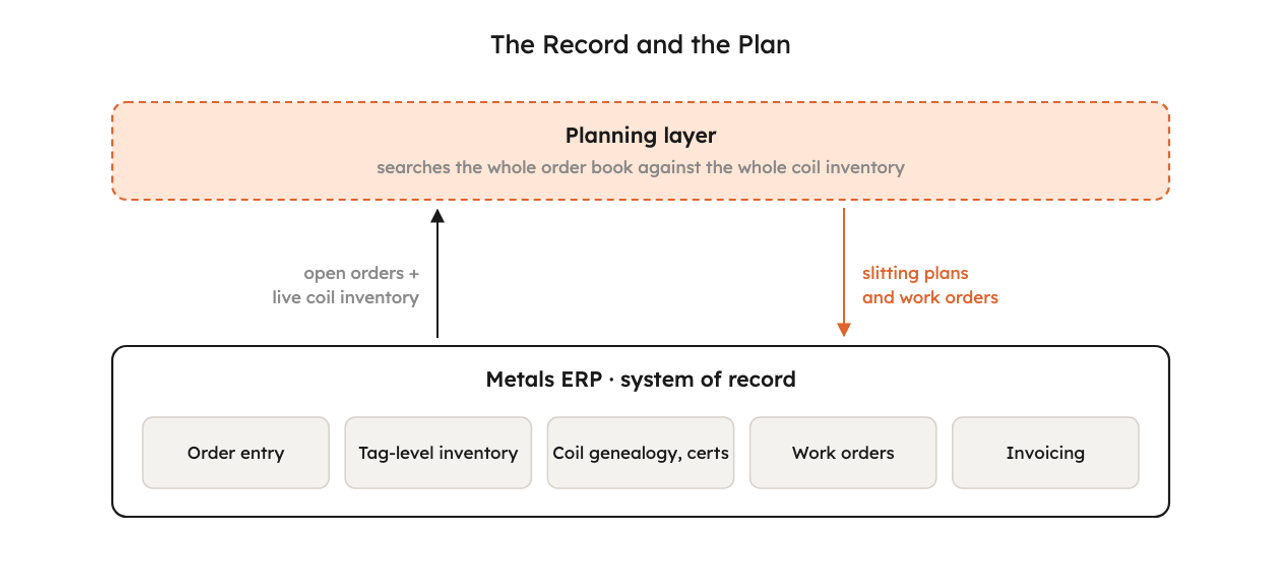
That boundary shapes the buying decision. If tag-level inventory or genealogy is unreliable, fix the record first, because no planner can work from data that is wrong, and the vendors above are the field to choose from. If the record is sound and the pain is scrap or planner hours, a migration that takes three months to a year will leave you with a better record of the same problem. Vasson, in the same Metal Center News roundup, names scope creep and "excessive customization and poor data quality" among the usual ways ERP projects go wrong.
The second case is the one LineSight AI was built for: a planning layer that reads the open order book and live coil inventory from whichever ERP you already run and returns slitting plans and work orders to it. Elite Steel added $850K in annualized revenue and cut its scrap rate 2.9 points after going live. The buyer's guide covers how to test a planning layer against your own orders.