Can AI Enter Purchase Orders Into Your ERP?
Yes, with a person approving each one. How AI gets customer, mill and outside processing POs into SSCS, INVEX or Eniteo, and how to test it on your own orders.

LineSight
October 27, 2026
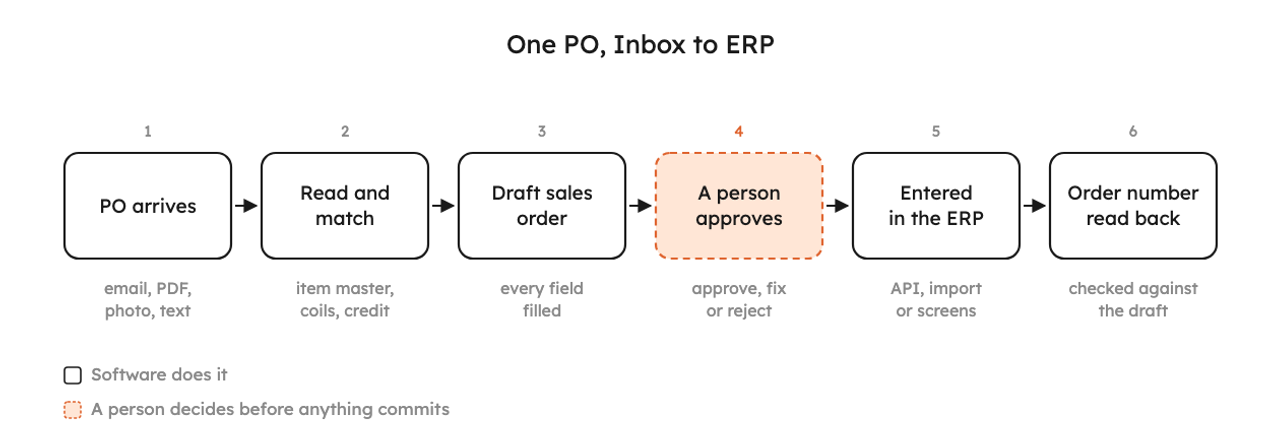
Yes. LineSight AI enters purchase orders into the ERPs metal service centers run, including P.S. Data's SSCS, Invera's INVEX and Enmark's Eniteo, and the arrangement that holds up has a person approve each entry before it commits. The phrase covers two different documents in a service center, though. A customer's PO becomes your sales order. The PO you send to a mill or an outside processor becomes a purchase order in your own system. LineSight AI enters both, with the same approval step in front of each.
Which purchase orders are we talking about?
The customer's PO is the one most people mean. It arrives as a PDF, a spreadsheet, a scanned fax, a phone photo, a text or a WhatsApp message, and its lines describe material rather than naming a part. Entering it means creating a sales order against the right customer, ship-to, item, weight and price basis.
The PO you send a mill is a buy. When the order book needs coil you don't have, a buyer places it with a mill or another service center, and the ERP needs a purchase order against that supplier with the grade, weight and due date, so receiving can match the coil when it lands.
The outside processing PO, often shortened to OPPO, covers work done on your metal at someone else's plant. If a coil goes to a toll slitter because your own line is booked, the ERP needs a PO for the service and a record that your material is sitting at their dock.
One customer order can create all three in a morning. Take 40,000 lbs of 16 GA G90 at 4.250 in that can't be filled from stock. It becomes a sales order, a PO to the mill for a master coil, and an OPPO if the coil is slit outside. LineSight AI drafts each of them from the same order.
How does the order actually get into the ERP?
There are three routes, and the one a tool uses on your system matters more than its demo.
The first is the ERP's API. When the ERP exposes a call that creates a sales order or a purchase order, the software sends the fields and gets an order number back. This is the cleanest route where it exists. The second is the ERP's import. Many metals ERPs accept orders from a file or a staging table, so the software writes the file, the ERP loads it, and any rejected lines come back with the reason.
The third route is for systems with neither. LineSight AI operates the ERP's own order entry screens the way a clerk does, under its own login. It opens the order screen, fills the header and each line, saves, and reads the result off the screen. Because it goes through the same screens a person uses, the ERP's own checks (credit holds, item validation, pricing rules) run exactly as they would for your staff, and the audit trail shows which user entered the order. If a clerk can key an order into your ERP, LineSight AI can too, which is why it connects to virtually any ERP rather than a fixed list.
Does it work with metals ERPs like SSCS, INVEX and Eniteo?
LineSight AI is live on SSCS, INVEX and Eniteo, and connects to other ERPs at onboarding by whichever of the three routes the system supports. Our comparison of metals ERPs covers who makes each one.
Some ERP vendors are building their own version. Ben Vaughn of P.S. Data told Modern Metals in February 2026 that SSCS "scans a purchase order and uses AI to merge the content into a sales order," with each model set up around "where they want validation checks by humans" (Modern Metals). If your ERP vendor offers this, run it on the same orders you use to test anything else.
Whatever the ERP, ask the vendor four things. Which order types does it enter: sales orders only, or purchase orders and OPPOs too? Which route does it use on your version? Does it read the order back after saving? And whose login does it enter under?
Which other tools enter purchase orders?
Several kinds of software answer this question, and they mean different POs. Accounts payable and procurement tools handle the POs you send and the invoices that come back; Yooz describes its product as covering the buying process "from requisition to purchase orders" and on to payment (Yooz). Order automation platforms handle customer POs. Conexiom says its Relay product automates "RFQs, orders, VOAs and invoices" (Conexiom), and Esker sells order-to-cash and source-to-pay automation to finance teams (Esker). Both serve manufacturers and distributors broadly, and our Conexiom and Esker comparisons go through the differences for a service center. Steelhead is a job shop ERP for metal finishers, with AI order entry that extracts PO details for staff to confirm inside its own system (Steelhead). oktogonAI builds AI agents that turn POs "into validated ERP transactions" for distributors and manufacturers (oktogonAI). LineSight AI is built for metal service centers, and after entry it carries the order on to coil matching, slitting plans and work orders.
What does a steel PO need that a generic tool misses?
A steel PO line describes material by gauge, width, grade and coating instead of naming a part number, quotes the quantity in one weight unit and the price in another, and carries tolerances that decide which coils can fill it. Read $48.50/cwt as $48.50 a pound and a 12,000 lb line goes from $5,820 to $582,000. Why a steel PO breaks generic AI order entry works through each of these.
What should a person still check before it commits?
In LineSight AI, every drafted entry waits for approval with the source document beside the extracted fields. The person approves it, fixes a field, or rejects it. Drafts the software is unsure about go into an exceptions queue with the reason attached, such as a description that matched nothing in the item master, a width wider than the master coil, a price that disagrees with the quote, or a message that looks like a revision of an order already entered.
After approval, LineSight AI enters the order and reads the ERP's order number back. It then compares the saved order with the approved draft, line by line. If the ERP dropped a line or a pricing rule replaced the approved price, the order goes back to the person instead of passing quietly.
The check is worth its few seconds because errors on a steel order cost metal. A strip slit to the wrong width usually ends as scrap at full material cost, and SteelBenchmarker put US hot-rolled band at $1,173 a net ton on 30 September 2026. A 20,000 lb coil is 10 net tons, so one wrong width can put about $11,730 of steel into the scrap bin before anyone has been paid to handle it.
How do you test it on your own orders?
Run two weeks of real orders through it. A demo on the vendor's sample PDFs tells you little, because the hard cases are particular to your customers: the buyer who still faxes, the spreadsheet with merged cells, the revision that arrives two hours after the original. At 40 POs a day, ten working days gives you 400 orders, enough to meet most of them.
Count how many orders went in untouched, how many needed one field fixed, and how many errors were caught at review before they reached the floor. Then check the read-back, meaning how many saved orders matched the approved draft exactly. If you want mill and outside processing POs covered, put them in the same test.
Judge order entry on those numbers alone. LineSight AI's published customer result, Elite Steel cutting scrap by 2.9 points, came from production planning, so it says nothing about how order entry will do on your mail. Your two weeks will.
Order entry is the step everything else waits on, which is why LineSight AI's Command Center treats it as the start of the run from PO to release. The same approved order goes on to the coil match, the slitting plan, the work orders and the freight, with a person signing off at each decision.