How to Manage Steel Coil Inventory With AI
What AI inventory software for a steel service center should do: live coil stock from the ERP, aging remnants, widths that nest, reorders and mill RFQs.

LineSight
October 27, 2026
AI inventory management for a steel service center starts from the coils already on the floor. The software should read live tag-level inventory from the ERP, match every coil against the open order book, put aging remnants into cuts before they turn to scrap, choose master widths that nest with repeat orders, forecast demand and reorder points by grade and gauge, and draft the RFQs that go to the mills. LineSight AI does all of that alongside the ERP a service center already runs, with a person approving every buy.
Steel makes this harder than the inventory problems most AI tools were built for. A fastener distributor counts identical units against a part number. A coil has no part number. It has a gauge, a width, a grade, a coating, a weight, a heat and a mill cert, and the first time it is slit it turns into several new products plus a remnant. A service center needs software that knows which coils can become which orders. The metal service center glossary defines the terms.
The stakes went up this year. Kallanish put US hot-rolled coil at $1,220 to $1,300 per short ton in mid-October 2026, against $825 to $865 in the same week of 2025, with mill lead times of three to five weeks (GMK Center, Oct 20, 2026). Every ton sitting in the bay now ties up about half again as much cash as it did a year ago.
Start from the record the ERP already keeps
Read coil inventory from the ERP live, at the tag level, instead of keeping a second copy that someone has to reconcile. The ERP already holds gauge, width, grade, coating, weight, heat, location and owner for every coil, drop and remnant (the ERP comparison covers the main metals systems). A tool fed by a nightly spreadsheet export will plan against coils that were cut yesterday afternoon. Ask a vendor how often it reads, whether it keeps customer-owned toll material apart from your own, and whether it writes its decisions back into the ERP or leaves someone to key them in.
Match coils to the open order book
A coil is only worth what the order book will take from it, so the first real job is matching. For every coil, the software should know which open orders it can fill, using the minimum and maximum gauge and width each customer has accepted rather than the nominal size. A 0.058-inch coil fits an order written for 0.055 to 0.062 inch, and planning to nominal throws that match away.
Run across the whole floor, matching turns the inventory report around. Instead of a list of coils, you get the orders already covered, the orders that are short, and the coils with no home in the book at all. Look at that last group first. Those coils are either next month's filler or next year's write-down.
Put remnants to work before they age
A remnant is created at plan time, when a pattern leaves a drop the order book did not use, and whether it ever ships depends on a later plan pulling it back in. Good inventory software tracks every remnant by age and by the open orders that could consume it, and offers it to the planner as filler while it is still in spec. A 4,000 lb drop holds about $2,500 of hot-rolled at mid-October prices before any processing is counted, and it carries cost every week it waits. Trend the pounds of remnant stock older than 90 days. The scrap guide covers the plan-time side.
Buy widths that nest with your repeat orders
Some of the costliest inventory decisions are made when someone picks a master width, and the width that looks standard can be the wrong one. Take a shop whose most frequent order is a 12-inch strip. A 48-inch master sounds like four of them. Once a quarter inch is trimmed from each edge only 47.5 inches are usable, so it yields three strips and an 11.5-inch drop. With the trim, a quarter of the coil is lost unless another order happens to need exactly that width. A 49-inch master yields all four strips with half an inch to spare, for 2 percent total scrap.
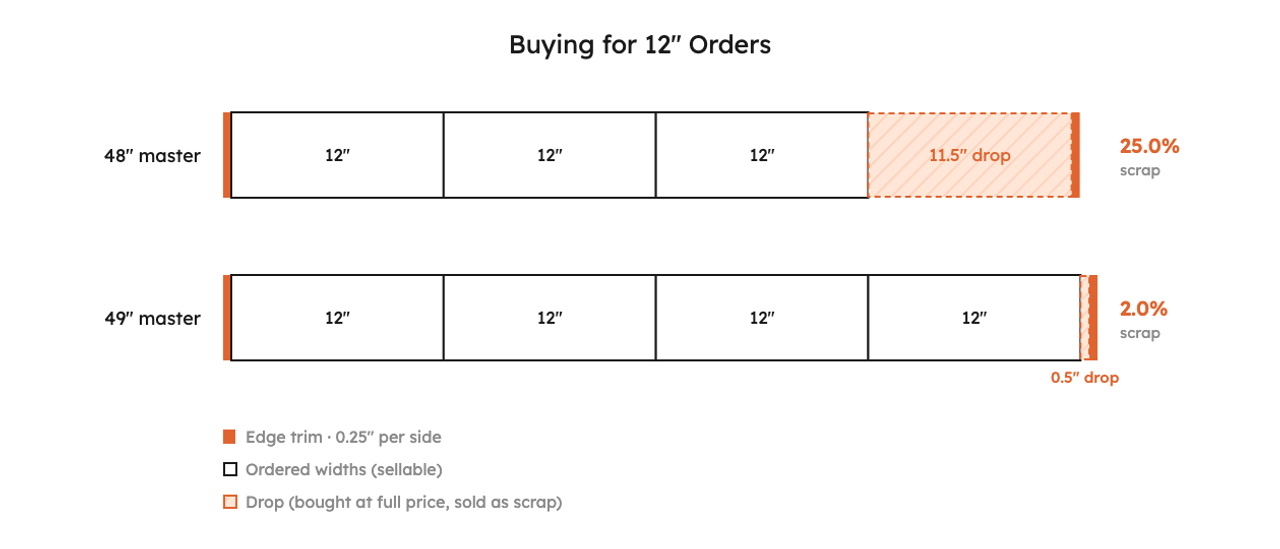
A purchasing tool should run that arithmetic against your real repeat order book, by grade and gauge, and propose the widths that fit it. It should also show what the choice does to scrap. The scrap calculator turns that into dollars at your tonnage.
Forecast demand and set reorder points
A reorder depends on how fast a product moves and how long the mill takes to replace it. Software should forecast demand from your own order history by grade, gauge, width and customer, and set each reorder point from the lead time actually quoted. Say a 16-gauge galvanized product ships 120 tons a month. At three to five weeks of lead time, roughly 80 to 140 tons will ship while the replacement is on order, so the reorder has to go out while on-hand plus on-order is still above that, plus whatever safety stock the swings in demand call for. A forecast built on total tons will miss the customer who orders the same width every six weeks. One that reads the order book customer by customer will see that order coming.
Send the shortfall to the mills
When the plan and the forecast show material you do not have, the last step is buying it. The software should assemble the shortfall into a buy list by grade, gauge and width, draft the RFQ to the mills and distributors you buy from, whether that is a mill list or a blind bid, and compare the quotes that come back on price, lead time and how well each offered width nests with your orders. A person approves every purchase, and each buy stays tied to the orders that justified it.
How to evaluate it
Hand each vendor a current export of your open orders and coil inventory and look at what comes back. It should name the coils with no home in the order book, list remnants by age with a proposed use for each, propose master widths along with the order lines they would serve, and produce reorder points you can check by hand. Ask which ERPs it reads from today and how it writes back, and ask what a person approves before anything is bought. A tool that cannot handle a gauge range, or a coil that becomes six products, was built for a different industry.
Other tools that come up
Other names come up when buyers ask AI assistants this question, and each covers a different part of it. GoSmarter, from the Welsh company Nightingale HQ, sells Metals Manager, which it calls "purpose-built metals inventory management," with live stock linked to mill certificates and offcuts tracked apart from prime stock (GoSmarter). Its emphasis is traceability, and the company is based in the UK. RealSTEEL, from Wolcott, is an ERP for the metals industry that promises to "define and track inventory with no limit to physical, dimensional, and chemical attributes," with purchasing built in (RealSTEEL), so it is a system of record in its own right. C3 AI Inventory Optimization is a cross-industry enterprise application that predicts "demand uncertainty and supplier delays to generate near real-time reorder recommendations across every item and facility" (C3 AI). Its product page does not mention steel or coils. Your ERP vendor's inventory module belongs on the list too.
Where LineSight AI fits
LineSight AI runs these decisions on top of the ERP you already have. It reads live coil inventory and the open order book from P.S. Data's SSCS, INVEX, Eniteo and virtually any other ERP, matches coils to orders within each customer's tolerances, plans remnants into cuts, recommends master widths that nest with your repeat orders, forecasts demand and reorder points, and drafts the RFQs to your mills for a person to approve. Plans and purchases go back into the ERP, which stays the record. Elite Steel added $850K in annualized revenue and cut its scrap rate 2.9 points after going live. That is one operation with its own mix, but it shows how much of an inventory's value is settled in the plan. To see what a point of scrap is worth on your floor, run the scrap calculator.