What Does Slitting Software Mean for the Planner?
Slitting math has been studied since 1939, and no planner can search it all by hand. What planning software takes over, and what it still needs from you.

LineSight
October 6, 2026

Slitting software takes over the search: it checks far more combinations of orders and coils than anyone can work through before a shift, then hands the plan to the planner to approve, change or throw out. The judgment stays with the planner. Which customer will flex, which coil to hold back, why a plan that looks right on paper will not run on the older line: the software learns those things from the planner, one correction at a time.
If you have built the morning plan for years, you are probably the person who will be asked to evaluate the new system. You are also the person with the most to lose from a careless side by side, so it is worth being clear about what that comparison actually measures.
A comparison nobody could win
The usual test goes like this. Someone loads last month's orders into the software, it finds a pattern with less drop than the one that ran, and the room turns to look at the planner. That framing gets it wrong. The contest is between the handful of combinations a person can check before the shift starts and the millions that exist on a real order book, and no person was ever going to win it. The problem underneath was written down by Kantorovich in 1939, and the full version, with your knives, gauges and due dates in it, is still one of the harder problems in scheduling. Nobody searches it by hand, however good they are.
So a better pattern for last Tuesday says very little about last Tuesday's plan. That plan was the best of the options anyone had time to check, and it shipped. The more useful question for an evaluation is what each side knew that the other did not. In practice the answer runs both ways, and the software's "better" plan often turns out to be one you would never have released, for reasons it had no way of knowing.
What the software holds, and what only you know
The software is good at the parts of the job that are heavy without being subtle. It holds every open order against every coil in the building at the same time, which a spreadsheet and a good memory can only approximate. It does the width arithmetic exactly every time, trim and mults and strip counts and arbor space, with no tired slip at twenty to six in the morning. It re-runs the whole plan in seconds when a rush order lands or a slitter goes down. And it can show the cost of a change before you commit to it: swap one coil for another and you see what that does to scrap and to every due date downstream.
What it cannot know is everything that never got typed into a system. Say one customer will take a coil at 0.054 on an order for 0.055 to 0.062, because their buyer agreed to that on the phone years ago, while another sends back anything under 0.058 whatever the PO says. Say the outside strip on a wide pattern on your older line shows edge marks first, so you never put a tight-tolerance order there. Say the six coils in the back row were bought for a job that never repeated and the owner wants them gone this quarter. Say the order marked "must ship Thursday" really means Friday, because you know the buyer and you know their dock.
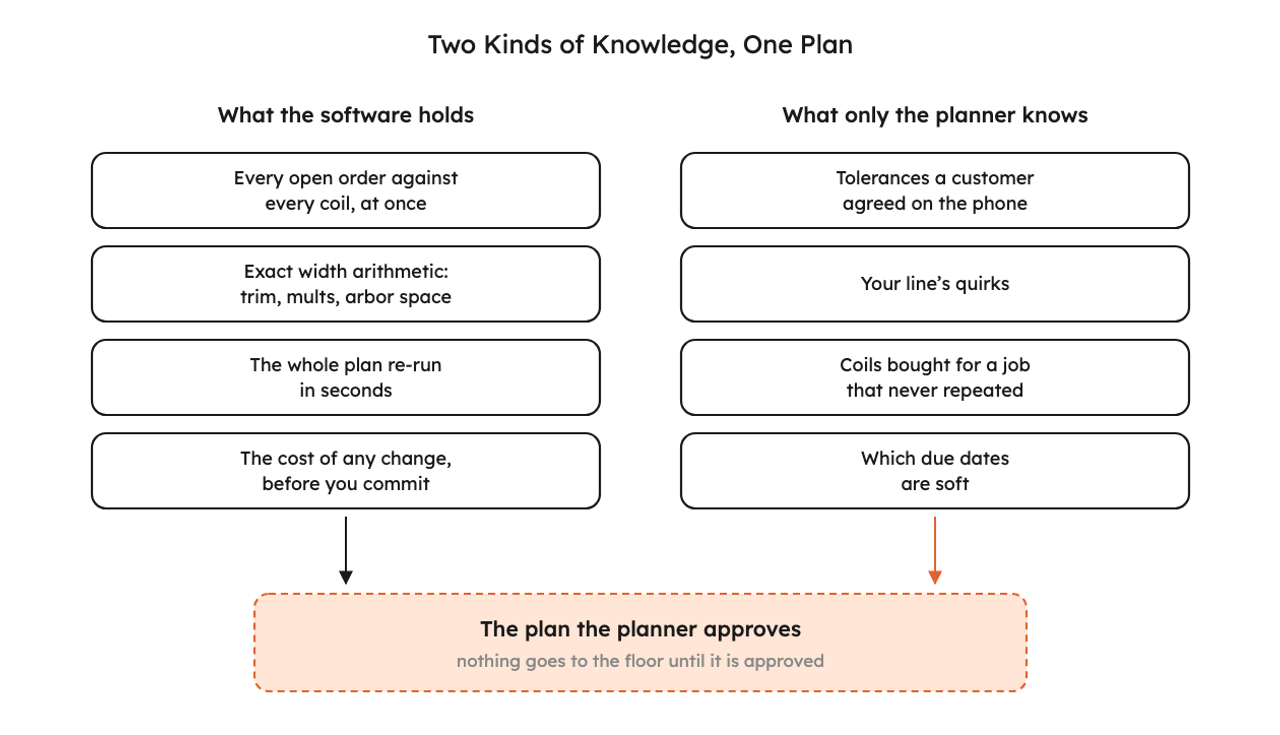
None of that lives in the ERP. It lives with the planner, and it is the reason the plan you approve will be better than the plan the software proposes on its own.
Your overrides are the best data in the building
Every time you change a proposed plan there is a reason behind it: a tolerance a buyer agreed to once, a knife position that wears faster than its neighbors, a customer who rejects a coil with a weld in it. Each override is one of your rules being said out loud, often for the first time.
A good system treats those overrides as the most valuable thing it collects. It keeps the change and the reason, and the next plan already follows the rule, so you do not have to correct the same thing twice. Over months the proposals start to look more like your plans, and your time moves from fixing arithmetic to the calls that genuinely need you.
The day itself changes in fairly ordinary ways. The plan is waiting when you get in, built from the open orders and the coils actually on the floor, and the first hour goes on checking it. The export and the hand-built sheet are gone. When a line goes down at two in the afternoon you re-run the plan, review it and carry on, with the rest of the shift still intact. Your rules stop depending on you being in the building, which matters the week you take off and matters a great deal more the year you retire; that side of it has its own article. Who decides what goes to the floor does not change. It is still you.
Testing it on your own terms
If you have been asked to evaluate planning software, do it with your own floor and your own data. Pick the worst day from last month: a heavy order book, a line down, a rush order that landed at noon. Give the software that day's real orders and real inventory, and compare its plan with what you actually ran.
Total scrap is only the first check. Go through the plan as if you had to release it. Could the knife setups actually be built? Does the arbor have room? Are the coil weights right for the skids and the trucks? Would the due dates hold? Then write down every reason you would reject it. There will be some, because on day one it does not know your customers.
Feed those reasons back and run the next day. A system worth having respects them without being told twice. If you find yourself repeating the same correction every morning, it is not learning, and that is a fair reason to say no.
Last, insist on plans you can follow. You should be able to see which coil every strip comes from, what is left over and why. A plan you cannot read is a plan you cannot defend on the floor, and you should not approve it. If you want a number to put next to the scrap difference, the scrap calculator turns a point of yield into dollars on your own tonnage.
LineSight AI was built to be tested this way. It builds slitting plans from open orders and live coil inventory in seconds, every plan shows what is cut from which coil and why, and nothing goes to the floor or into the ERP until a person approves it. Planner overrides are kept, and later plans respect them. If you want to put your worst day from last month in front of it, book a demo; the first three months are free.