The Other 65-Year-Old Running Your Slitting Line
The hardest math problem in metals turned 65 this year. So did a lot of the people who solve it by hand every morning. Only one of them is retiring.

LineSight
June 15, 2026
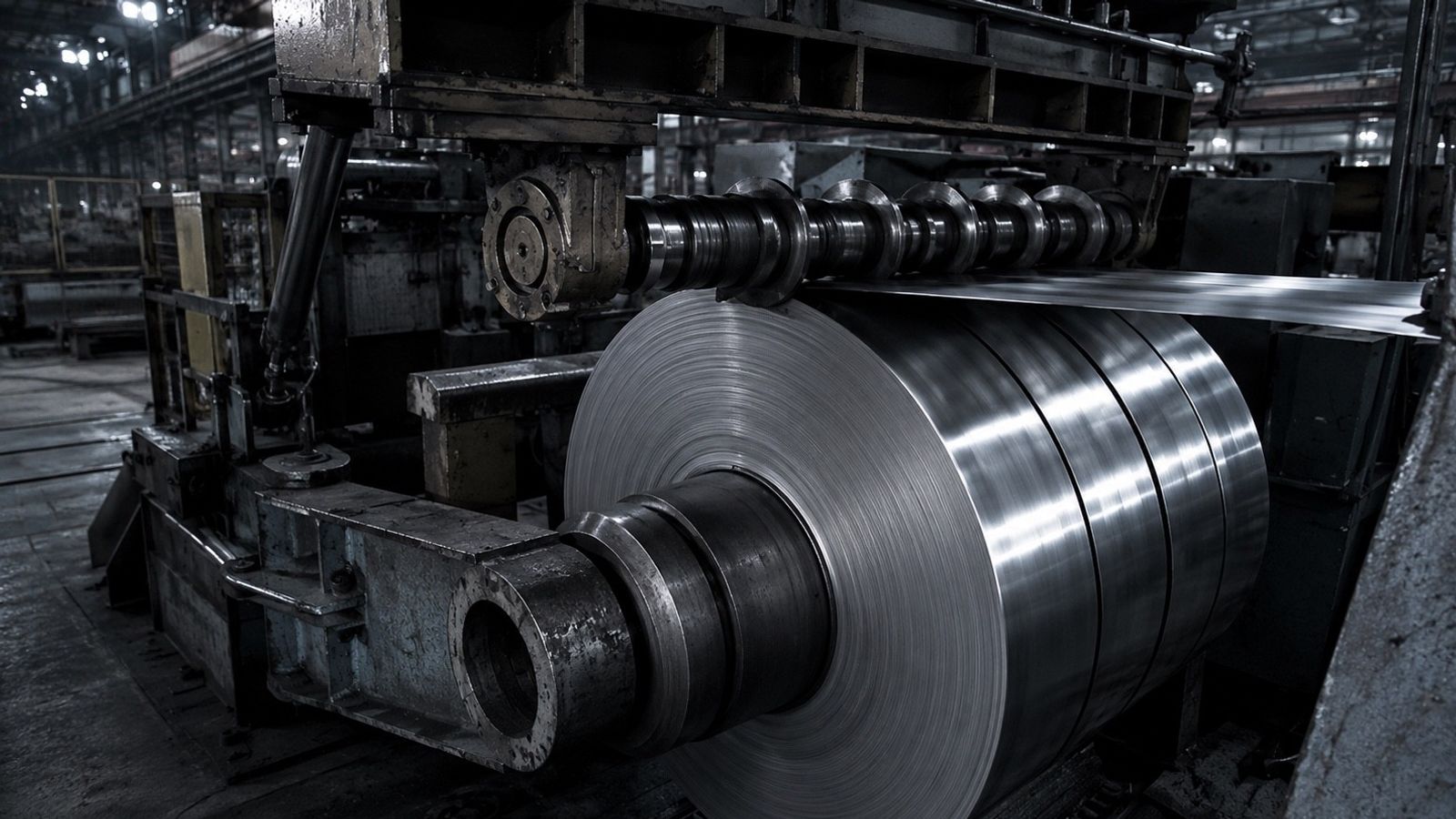
The hardest decision on a slitting floor is made every morning before the first coil is loaded, and at most metal service centers it is made by one person. Started in the warehouse in the eighties. Moved into the scheduling chair when the last scheduler retired. Has built the morning cut plan ever since, through three owners, two ERPs, and every steel cycle in between. The planning technology is not a system. It is a person.
The math behind that plan is genuinely hard, and we have written about both why it is one of the hardest problems on the floor and why the ERP cannot solve it. A record system answers questions that have one true answer. Planning is a search for a good answer among millions, and if that search does not happen in software, it happens in a head. The industry has been comfortable with that for decades, because the head was always there in the morning. The demographics now say it is ending, and they say it with unusual precision.
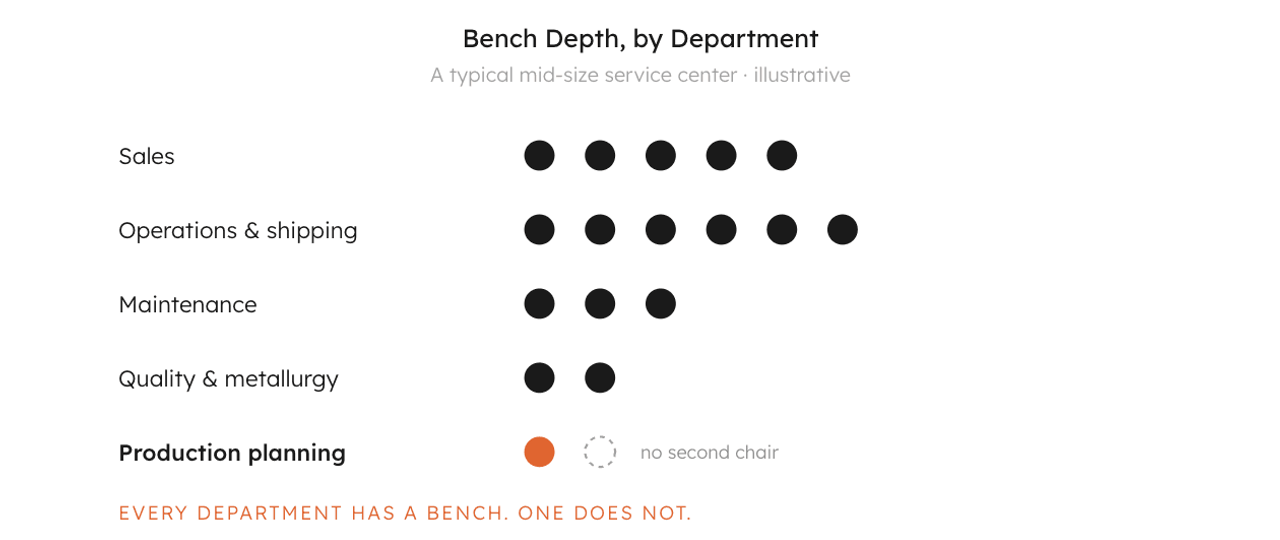
The planning department is one person deep
Walk the org chart of a typical service center. Sales has a bench. The floor has a bench. Maintenance has a bench, and when it runs short you can hire a millwright and know roughly what you are getting. Then there is the scheduling chair. In most operations the knowledge in that chair is one person deep. Sometimes two, and the second is still learning. There is no contract scheduler market to call in February, because the job is not portable. The constraints that matter are the ones specific to your machines, your customers, your floor.
Consider what sits in that chair. Which orders can share a setup and which only look like they can. Which customer accepts a short coil and which sends it back. What the older slitter does to heavy gauge on a cold morning. Which due dates are real and which were a salesperson being optimistic. None of it is in the ERP. None of it is in the spreadsheet. It walks in at six and drives home at four.
The demographics are not a forecast
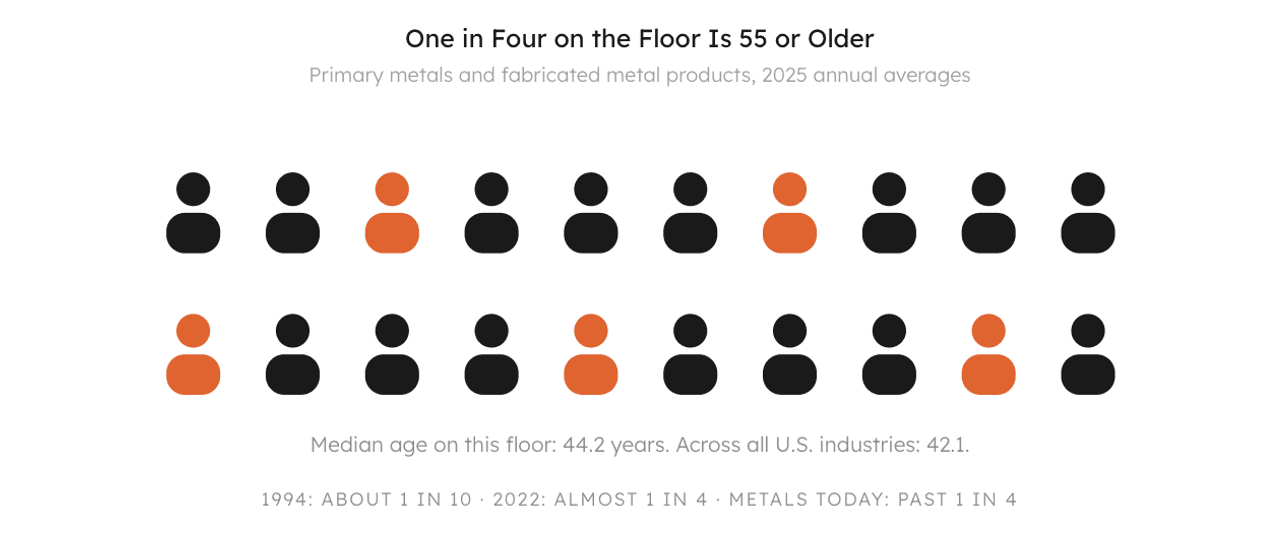
The aging of the industrial workforce is usually discussed as something coming. It is not coming. It happened. In 1994 about one American worker in ten was 55 or older. By 2022 it was almost one in four. Metal is ahead of the average: in primary metals and fabricated metal products, more than one worker in four is already 55 or older, and the median age is 44.2, two years above the workforce at large.
The concentration is the sharper number. In 2000, 14 percent of manufacturing employment sat at firms where at least a quarter of the workers were over 55. By 2022, more than 40 percent did. The experience is not spread evenly across the industry. It pools in particular buildings, and inside them, in particular chairs. Manufacturers know it: even before the wave crested, 97 percent said they were concerned about the knowledge that leaves with retiring workers. And the replacement math offers no rescue. Deloitte and the Manufacturing Institute project a need for as many as 3.8 million new manufacturing workers by 2033, and estimate that 1.9 million of those seats could go unfilled.
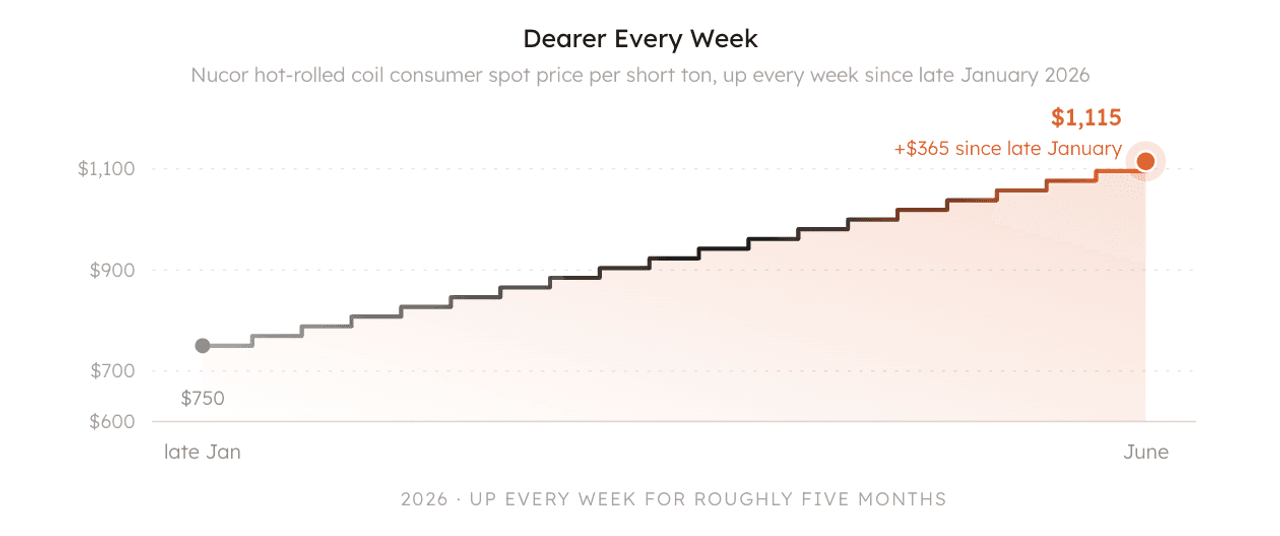
Meanwhile each planning decision is worth more than it was in January. Nucor's spot price for hot-rolled coil has risen every week since late January, $365 a ton over the run, to $1,115 this week. Service center steel shipments rose again in April. More tons, dearer steel, and the same one chair deciding how much of every coil ships as product instead of scrap.
Why none of it is written down
More than half a century ago, the philosopher Michael Polanyi put his finger on why this job resists every manual: we can know more than we can tell. Human skill runs ahead of human language. A scheduler who has planned a line for thirty years knows things in a form that does not survive being turned into rules.
Every shop that has tried to capture a retiring expert's knowledge has met the same wall. Ask the scheduler to document the process and you get rules: hold the edge trim at half an inch, never mix those two gauges. What you do not get is the weights. When the half inch rule is worth breaking. Which gauge mix is acceptable for which customer in which week. Rules are procedures, and procedures fit in a binder. Judgment is tradeoffs, and the tradeoffs were learned one morning at a time, over thousands of mornings. Typing the rules into the ERP does not help either. A custom field is still a record. You end up owning a perfect description of the problem and nobody left who can solve it.
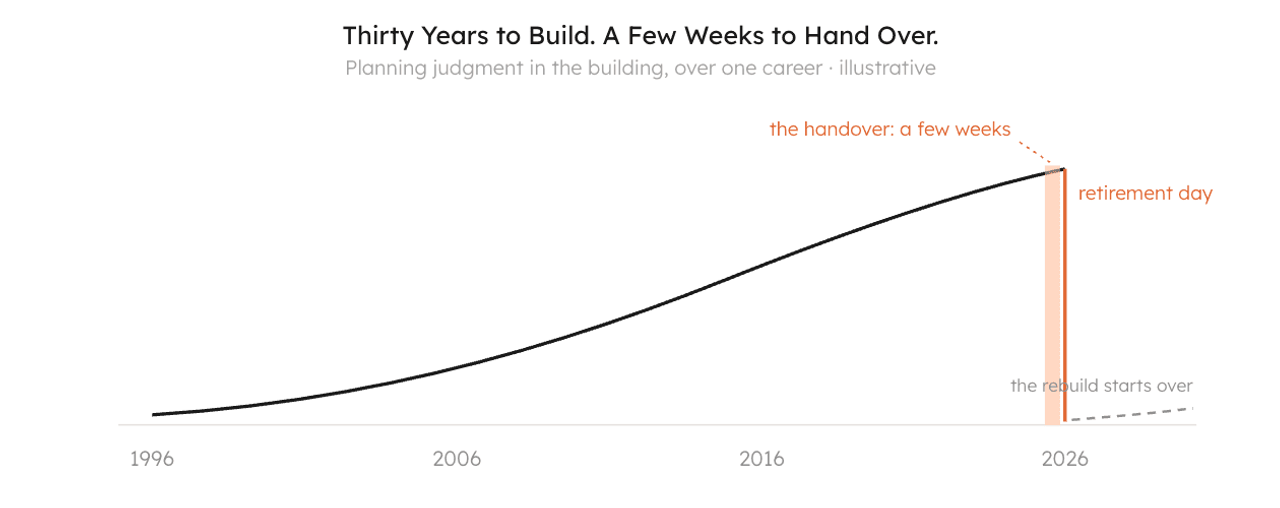
Shadowing works. It is how the current scheduler learned. It is also slow, because tacit knowledge transfers at the speed of worked examples. Thirty years of mornings built the judgment. The handover, when it finally comes, gets a few weeks of them.
Succession for a search
The way out is to stop treating the scheduler's knowledge as one thing. It is two. There is the search: holding the whole order book against the whole coil inventory and finding the combinations that waste the least. That part was never really human work. It is heavy, repetitive weighing that a person can only approximate because someone has to, and software built for the metal service center version of the job can run it properly, weighing far more combinations than a morning allows, every constraint at once. Then there is the judgment: which customer can flex a day, which coil to hold back for a job that has not landed yet, when the plan that looks right on paper is wrong for a reason that lives on the floor. That part stays with the person. And it is finally capturable, not as documentation but as behavior. Every override is a worked example the system keeps.
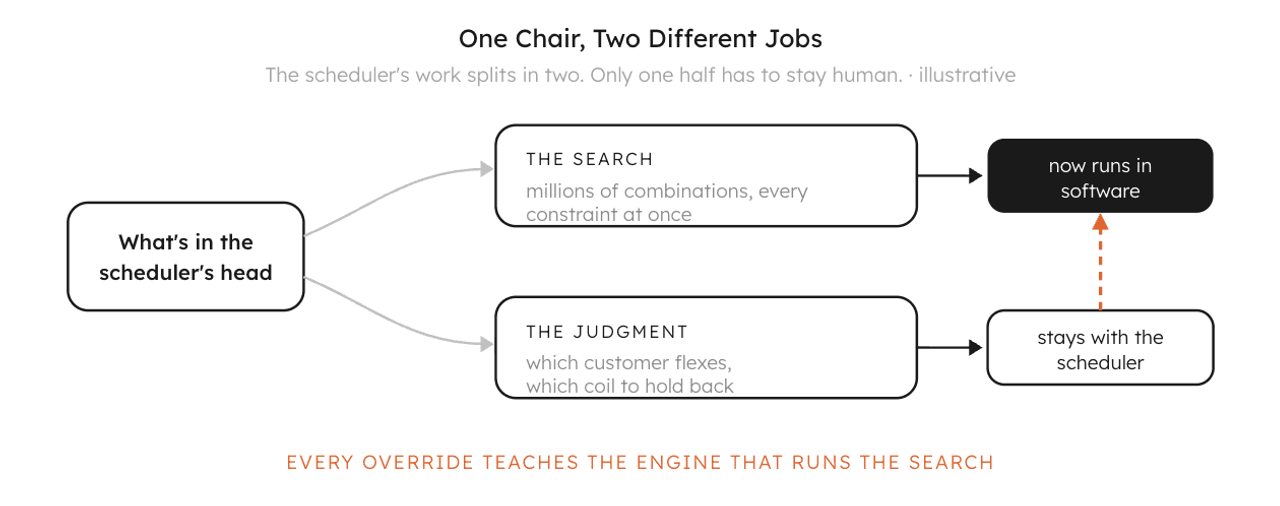
This is what LineSight builds for coil production planning, and it quietly changes what retirement means for the operation. The plans, the alternatives, the overrides and the reasons accumulate in an engine that does not leave, while the scheduler is still on the floor to teach it. A service center runs on decisions. Planning is the first one whose succession can be solved this way. It will not be the last.
The hardest job on the floor is not going anywhere. The person who has done it in their head for thirty years is. The only question is whether what they know leaves when they do.
This piece was written by the LineSight team. LineSight builds AI powered software that automates coil production planning for metal service centers. linesight-ai.com
Sources
U.S. Bureau of Labor Statistics. “Employed People by Detailed Industry and Age.” Current Population Survey, Table 18b, 2025 annual averages. bls.gov/cps/cpsaat18b.htm
U.S. Census Bureau. “U.S. Workforce Is Aging, Especially in Some Firms.” December 2, 2025. census.gov/library/stories/2025/12/older-workers.html
Deloitte and The Manufacturing Institute. “Taking Charge: Manufacturers Support Growth with Active Workforce Strategies.” April 2024. themanufacturinginstitute.org
The Manufacturing Institute. “The Aging of the Manufacturing Workforce.” July 2019. themanufacturinginstitute.org/research
Steel Market Update. “Nucor Increases Spot HR Price by $10/ton, Again.” June 8, 2026. steelmarketupdate.com
Metals Service Center Institute. “U.S. and Canadian Shipments Rise Across Steel and Aluminum.” Metals Activity Report, May 26, 2026. msci.org
Michael Polanyi. The Tacit Dimension. University of Chicago Press, 1966; reissued 2009. press.uchicago.edu
LineSight. “The 65-Year-Old Math Problem Running Your Slitting Line.” June 2026. linesight-ai.com/blog
LineSight. “Why Your ERP Can’t Plan a Slitting Line.” June 2026. linesight-ai.com/blog
Header image: steel coil slitting line, generated illustration by LineSight.