What Does a Well-Run Slitting Operation Look Like?
A well-run slitting operation plans the whole order book before the shift, tracks scrap by cause every shift, ships on time and gets its planner home by 4.

LineSight
October 6, 2026
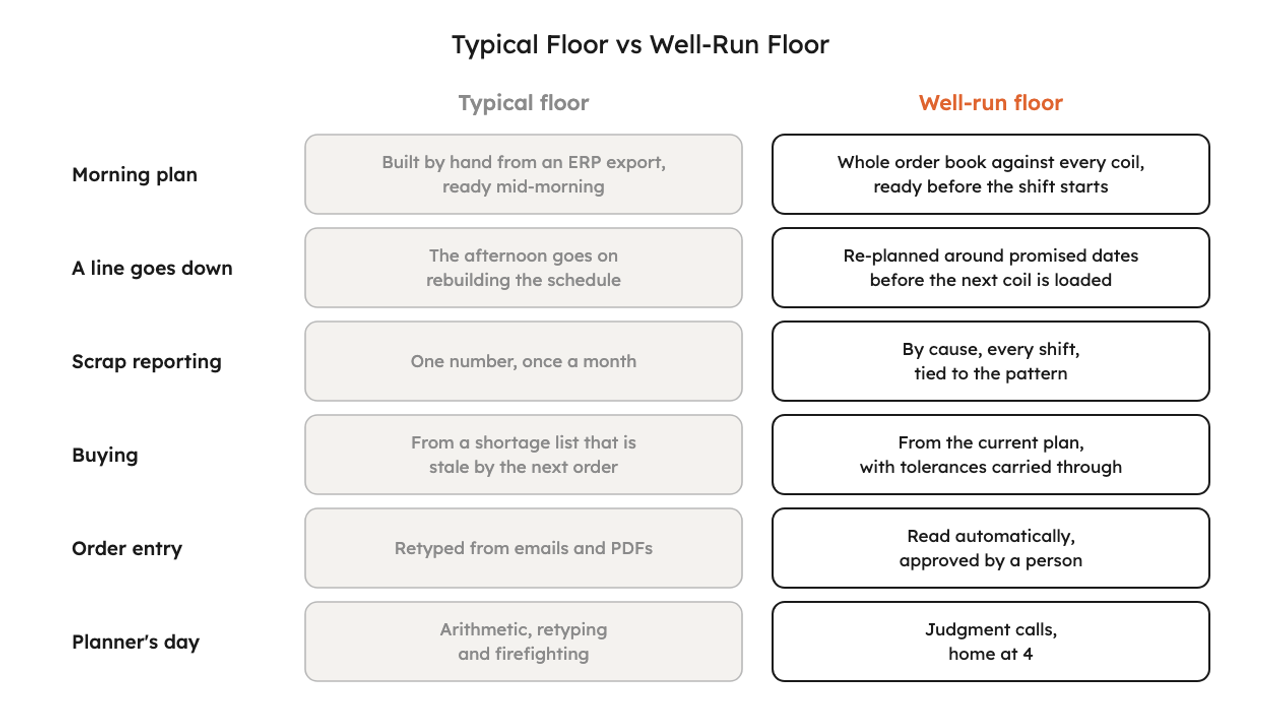
A well-run slitting operation builds its plan from the whole open order book and every coil in the building before the shift starts, and rebuilds it whenever an order, a coil or a machine changes. It tracks scrap by cause every shift, buys steel against the orders it actually has, ships on the date it promised, and gets more tons through the same line by grouping setups. Its planner goes home at 4. Almost all of that comes from how the work is planned and measured, and how close a shop is can be checked with three numbers most already keep.
The picture matters most to whoever has to argue for change. A VP of Operations usually knows where the hours and the pounds go. The owner usually sees a monthly scrap figure and a planner who never seems to leave, and reasonably asks what better would look like on this floor, with these people and these machines.
Six-thirty to four
At 6:30 the overnight purchase orders are already in the ERP. They arrived as emails and PDFs, were read and entered, and someone on the order desk approved each one before it went in. Nobody retyped a part number. By 7:00 the planner has a plan that covers the full open order book against the live coil inventory, showing what each master coil will be cut into, what is left over, and why. The planner makes two changes: one customer will take a heavier gauge this week, and one coil is being held for a job that has not landed yet. The plan comes back in seconds with both changes respected, and it keeps respecting them tomorrow.
By 8:00 work orders are on the floor, with setups sequenced so that patterns sharing a knife arrangement run back to back. At 10:15 a slitter goes down. The planner marks it out of service and the remaining work is re-planned across the other lines, with promised dates protected first. On a spreadsheet floor this is where the afternoon goes. At 2:00 the buy list reflects the morning's plan and the orders that came in since, so the buyer is ordering against today instead of Monday's shortage list. At 4:00 the planner leaves, and tomorrow's queue is already staged.
What the planner spent the day on is the part worth noticing. Which customer can flex a day, which coil to hold back, when a plan that looks right on paper is wrong for a reason that lives on the floor: that is judgment, and it is where an experienced planner earns their pay. The search through combinations and the retyping are the parts software does well, and what slitting software means for the planner covers how that split works day to day.
Scrap with a name on it
Most shops know their scrap rate. Fewer know it by cause. A well-run floor splits scrap into edge trim, head and tail, width rejects and remnants (the drop left when a pattern does not fill the master width), and reports it per shift and per pattern. Edge trim that creeps up points at patterns built too close to the minimum. Remnants that pile up point at the plan, or at buying. A single monthly percentage, weighed at the bin, gives nobody anything to act on. If you want a dollar figure on one point of scrap at your own tonnage, the scrap calculator does the arithmetic.
Buying runs on the same discipline. On a typical floor the buyer works from a shortage list taken when the plan was approved, and that list is out of date by the next order. On a well-run floor the buy list comes out of the current plan and moves when the order book moves. Tolerances carry through, so a 0.058 coil counts against an order for 0.055 to 0.062 instead of showing up as a shortage and getting bought twice. A quick test is to walk the oldest inventory in the building. If much of it was bought for jobs that changed or never repeated, buying has been running on a stale list, and that steel is sitting on the floor at the price you paid for it.
Minutes at the knives
Throughput on a slitting line is mostly decided before the coil is loaded. The line runs at the speed it runs; what changes from one schedule to the next is how often it stops. The arithmetic fits on a napkin: knife changes per shift times minutes per changeover is the time the line stands still for setup. Say a shift sees eight knife changes at 25 minutes each. That is more than three hours a shift with the line stopped, before a coil jams or a truck runs late.
A well-run schedule goes after that number directly. Patterns that share a knife arrangement run back to back. Coils are staged in sequence so the next one is ready when the last one clears. Short runs of the same gauge are combined across customers, so the line is set up once for three small orders instead of three times. The complication is that setups and yield pull against each other. A pattern that saves a changeover can leave more trim than the changeover was worth, and the pattern with the least trim can need a setup of its own. Most floors make that call by feel. Making it well means weighing both sides in the same terms, minutes of line time against pounds of steel, across the whole day's schedule at once.
Dates the plan can see
On-time delivery follows from a plan that knows the dates. On many floors the plan knows widths and gauges while the dates live with the order desk. A well-run floor flags must-ship orders honestly, plans them first, and uses orders with room in their dates to fill out patterns and close drops. Honesty is the hard part. When most of the order book is marked must-ship, the flag stops carrying information, and the plan can no longer tell which truck matters.
When a line goes down, the real question is which promises are now at risk and what has to move to keep them. A plan that carries the dates can answer that before the next coil is loaded; a plan rebuilt by hand answers it sometime after lunch. Measure the result against the date you originally promised the customer, not the date it was later revised to. A revised date that is always met tells the owner very little.
Three numbers for the owner
Owners respond to their own numbers, so bring three. The first is scrap by category over the last year (edge trim, head and tail, width rejects and remnants), even if the split has to be estimated the first time. The second is knife changes per shift for a typical week, with the average minutes per change, which turns into hours of standing line. The third is on-time delivery against the original promise date. Together they cover the steel, the line and the customer, and they become the baseline any change gets measured against.
It also helps to show the owner that the lever is real. Elite Steel, one service center running LineSight AI, cut its scrap rate by 2.9 points and added $850K in annualized revenue, with gross margin up 20%. That is one operation with its own mix of gauges, customers and coil, so read it as one shop's result and use your own three numbers to size what is possible on your floor. LineSight builds slitting plans from open orders and live coil inventory in seconds, shows what is cut from which coil and why, keeps the planner's overrides, and has a person approve every plan before anything reaches the ERP or the line. If you want to see your own order book planned that way, book a demo; the first three months are free.