Slitting Strip for Tube Mills: Width, Edges and Scrap
A strip 0.030 inch narrower can save 25 to 30 pounds per slit coil. How strip width, edges, camber and mult planning decide scrap when you slit for tube.

LineSight
October 6, 2026
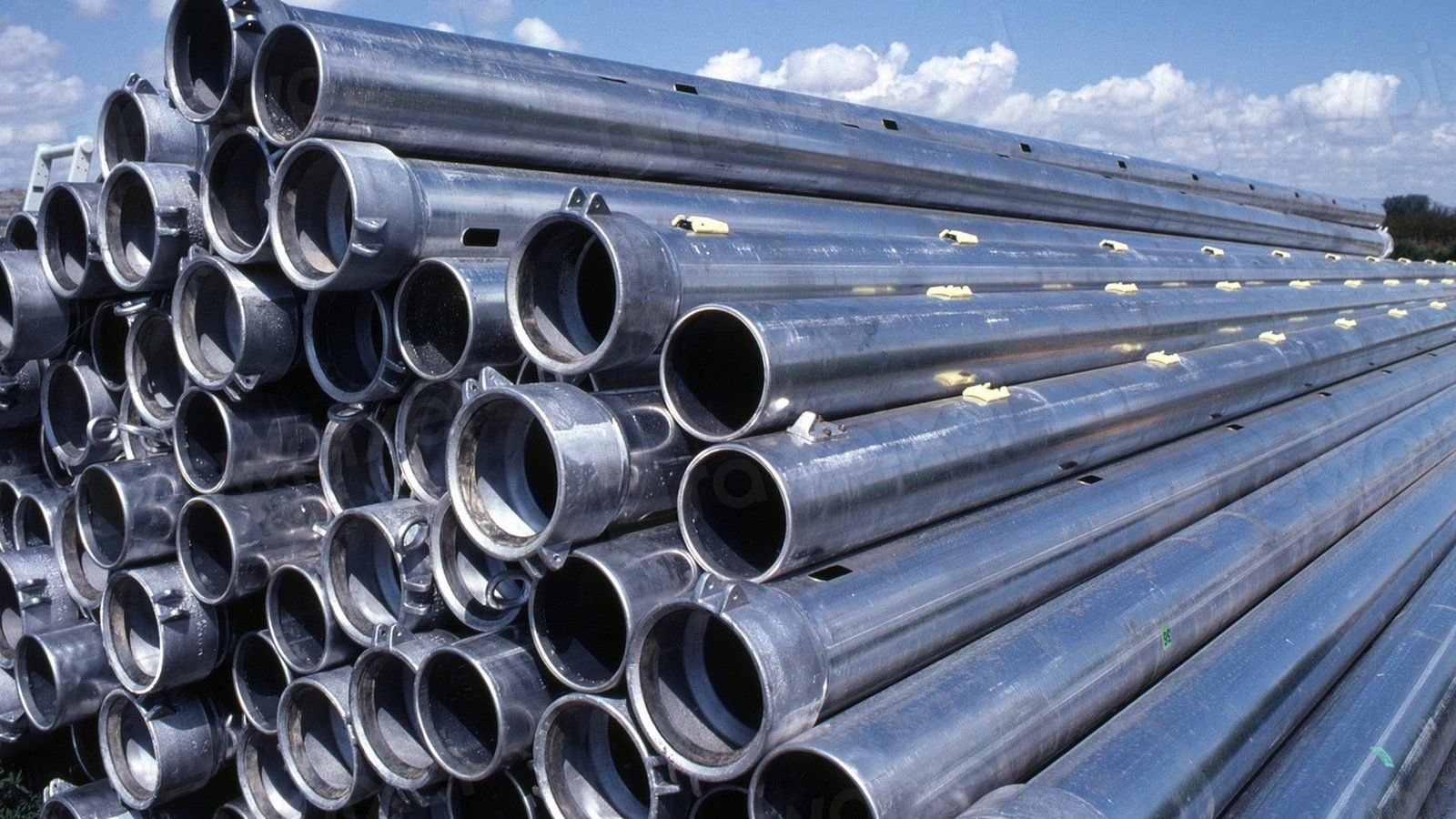
Strip for a tube mill is slit to a width the tube dictates. It comes from the tube's diameter at the weld rolls and its wall thickness, plus allowances for weld squeeze-out and the fin rolls, and it changes with every tube size and gauge. Because the edges of that strip become the weld seam, edge condition, burr direction and camber matter as much as the width itself. And because each tube size needs its own width, most of the scrap on the master is decided before slitting starts, by which tube sizes get combined on it.
That holds whether you are a service center slitting for tube and pipe producers or a tube producer slitting your own masters. The steel is bought by the pound and the tube is sold by the foot, and nearly every decision on the slitter moves one of those two numbers.
The tube sets the width
Jeff Shelton, writing in The Fabricator, gives the working formula in Buy it by the pound, sell it by the foot: strip width equals the diameter at the weld rolls minus the wall thickness, times pi, plus an allowance for weld squeeze-out and an allowance for girth reduction in the fin rolls. The first term is geometry. The two allowances belong to the mill: how hard it squeezes the weld and how much its fin passes take out of the circumference.
That is why one tube size rarely has one strip width across every customer. Roll-Kraft lists material type, gauge, breakdown design, fin pass configuration and welding method as factors that move it, and notes that "lighter gauge materials often require wider strip widths, while heavier gauge materials may require narrower widths." A service center slitting for three tube producers can easily carry three widths for what looks on paper like the same tube.
Getting it wrong costs in both directions. Shelton writes that "many transient problems in the forming and welding process are attributable to improper strip width (usually the problem is too little, not too much)." Too much width has its own list of effects: "excessive wall thickening; work hardening of the strip edge; excessive weld power required; cold welds." The safe instinct is to slit a little wide. The trouble is what a little wide adds up to.
A few thousandths, every foot
Tube is sold by length, so every pound of steel that does not need to be in the tube is given away. Shelton puts a number on it: "a strip width reduction of 0.030 inch would result in an average savings of 25 to 30 pounds per slit coil." Say a mill runs 2,000 slit coils a year of one size. That is 50,000 to 60,000 pounds of steel bought and shipped inside tube that would have been just as long without it. He is careful to add that pushing width down risks giving the savings back in scrap and unhappy customers, so the right width is one the mill has proven, not the narrowest one that welds on a good day.
Gauge works the same way. Bud Graham, also in The Fabricator, writes that "tube wall thickness is almost always over tolerance", largely because producers buy coil from several suppliers with different practices. Heavy wall is more pounds per foot, and the customer pays for the feet. His summary is blunt: "Cambered strip and off-gauge raw material remain the uncontrolled variables in welded tube production and the principal reason for loss of profit." The slitter cannot fix gauge, but the person planning it can know which masters run heavy and route them where the giveaway costs least.
The edge is the weld
On most slit products the edge is a detail. On tube it is the joint. Lew Warren, in Skelp edge preparation for manufacturing ERW pipe, notes that heat penetration into the edges for a 450,000 cps welder is about 1/32 inch, and that "irregularities ... that approach 1/32 inch may produce welding defects." The same article points out that slitting and side trimming "can affect surface appearance, width dimension, flatness, camber, and edge wave." All of those show up later at the weld box, usually as scrap tube.
Burr direction is part of the spec too. Lee Kothera writes in Presenting coil to a tube mill that slit coils carry a burr up or down, and "this burr should always be in the same relative position" as strip enters the mill. A slitter that winds some mults one way and some the other hands the mill a problem it has to catch at the uncoiler.
Kothera also makes the case for coil length. His example is an accumulator that could hold about 2,000 feet, fed by a coil only 792 feet long: "You cannot put 1,500 feet of strip in the accumulator when the coil used to fill the unit is only 792 feet long. The only way to refill the unit is to stop the mill." Coil length comes from the master's weight and how the slitter breaks it. Short breaks taken to hit a weight limit, or the tail end of a partly used master, can turn into mill stops at the customer.
Two tube sizes on one master
The scrap on a tube master mostly comes from the gap between its width and a whole number of strips. Take a 60-inch master with a quarter inch of edge trim on each side, as an example, and a tube whose strip is 9.40 inches. Six strips use 56.40 inches and leave 3.10 inches of drop. Add the trim and 6% of that master's width is bought as steel and sold as scrap.
Now put a second tube size on the same master, one that shares the gauge and grade and needs a 6.20-inch strip. Five strips of the first and two of the second use 59.40 inches. The drop falls to a tenth of an inch, and the loss to 1%. Nothing about either tube changed. The second size simply fills the space the first one could not.
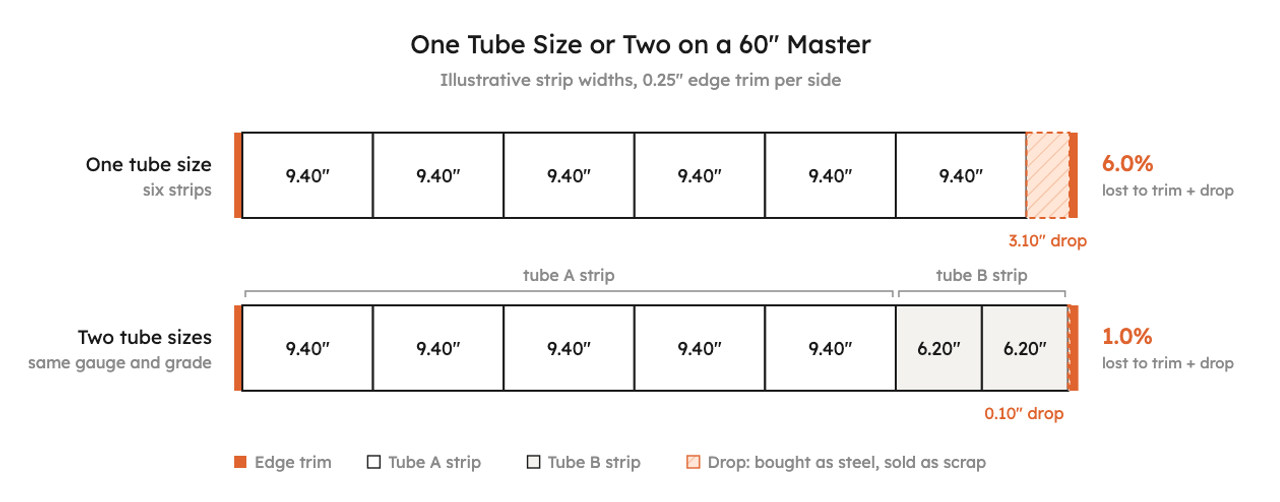
The arithmetic is unforgiving in the other direction too. Slit the 9.40-inch strip 0.030 inch wide, Shelton's number, and the five strips grow by 0.15 inch. The mixed pattern now needs 59.55 inches, more than the master has. One habit of slitting a little wide quietly turns a 1% pattern back into a 6% one.
Shelton notes that a producer buying masters and slitting them in house can "optimize strip widths at essentially no cost," while "a dedicated slitter tooling set may make strip width changes costly or difficult." That is the catch for mixing sizes. Combining tube sizes needs orders for both in the same gauge and grade, in quantities that line up, at a time the knives can be set for it. Finding those combinations across a whole order book and coil inventory is the hard part, and it is the same search we described in the 65-year-old math problem running your slitting line.
Planning the master
The tube version of slitting adds rules most planners already carry in their heads: the agreed width for each customer and size, burr direction, minimum coil length for a given mill, which suppliers' masters run heavy. Those rules are where yield is won or lost, and they are easiest to keep when the plan itself holds them.
LineSight AI builds slitting plans from open orders and live coil inventory in seconds, combining sizes across orders where the gauge and grade allow it. Every plan shows what is cut from which coil and why, a person approves it before anything goes to the ERP or the floor, and when a planner overrides a width or a pattern, later plans respect it. At Elite Steel, the scrap rate came down 2.9 points after going live. To see what the drop on your own masters is worth, try the scrap calculator. If you want to see it on your own order book, book a demo; the first three months are free.