How Do You Reduce Slitting Scrap on Automotive Work?
PPAP can call for 18 elements, and a process change may need customer approval. How slitters cut scrap on automotive work while the plan obeys those rules.

LineSight
October 6, 2026

On automotive work, slitting scrap comes down the same way it does anywhere else: by planning the whole order book against the whole coil inventory at once. The difference is that the plan has to carry customer approvals and coil genealogy as hard constraints from the first pattern, because a pattern that breaks either one cannot run, however little it wastes. Those rules leave fewer legal patterns to choose from, which makes a thorough search worth more.
Anyone who slits for stampers and tier suppliers, or runs a slitter inside a parts plant, knows the shape of the work. Specs are tight, grades keep getting stronger, and releases arrive daily and change by the day. Every slit coil has to be traceable to the master coil it came from. None of that is news to the quality department. What tends to lag is planning, which in many shops still builds the schedule first and checks it against approvals and traceability afterwards.
The approved process is part of the spec
Automotive parts go through the Production Part Approval Process. As Quality-One describes it, "The PPAP process consists of 18 elements that may be required for approval of production level parts. Not all of the elements are required for every submission." A PPAP "is required for any new part submission as well as for approval of any change to an existing part or process." Customers then add their own requirements. Ford's June 2026 PPAP specifics say suppliers are "required to obtain Ford approval per the Ford SREA Process (Supplier Request for Engineering Approval) prior to implementation of any organization-initiated or sub-tier supplier-initiated change."
That changes the meaning of a good idea on the planning desk. On general flat-rolled work, filling an order from a different source coil or moving it to the other line is ordinary schedule housekeeping, the kind of thing a planner does many times a week. On an approved part, the same move may count as a change to the process. Which moves count depends on each customer's requirements and on what was actually approved for that part, and the quality team is the authority on both. The plan needs to hold their answer as a rule attached to the part. Without it, the schedule keeps proposing patterns the floor is not allowed to run, and someone has to catch each one by hand.
Every mult has a parent
IATF 16949 expects a supplier's records to tie material to its paperwork. The IATF's published FAQ explains that the intent of clause 8.6.5 is to check supplier conformance records "to assure that the lot code, batch number, or comparable traceability information for the product are covered by the evidence provided by the supplier." On a slitting line, that comes down to coil genealogy: each slit coil traces to its master coil, and through it to the heat and the mill cert.
A case documented by WorldAutoSteel shows why this matters on the slitter in particular. A DP980 coil was bound for a rocker panel. According to AHSS Insights, "A master coil was slit into several narrower coils (mults) before being shipped to the stamper. Only a few mults experienced edge fractures, which all occurred along the slit edge." On one mult, every blank fractured at the slit edge during forming. Another mult from the same master coil had a good edge.
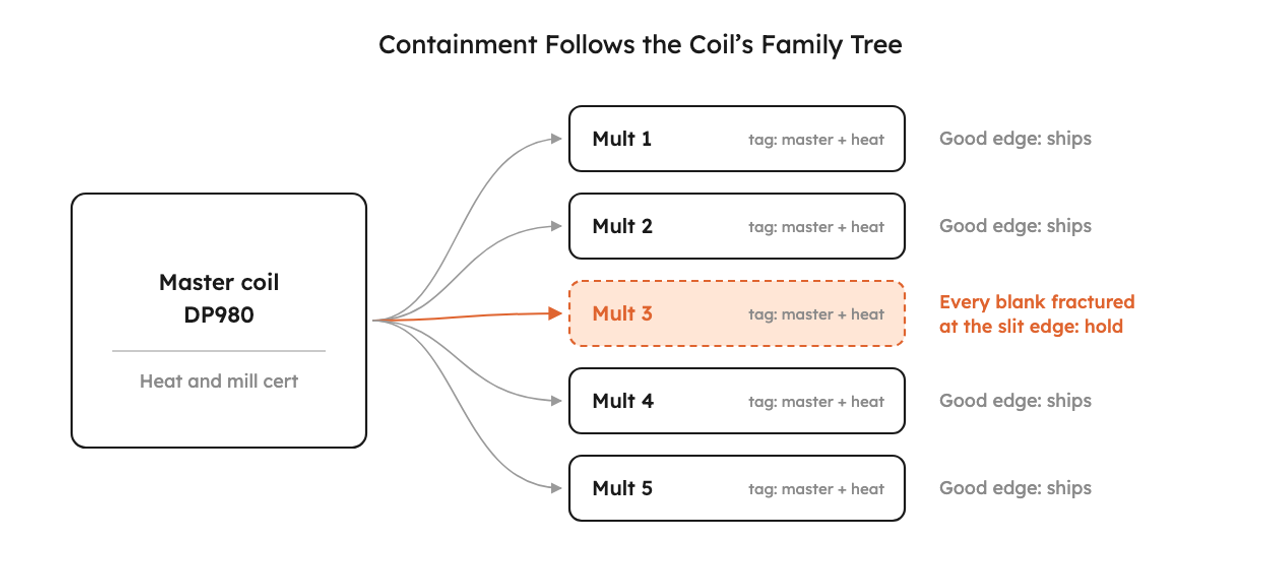
When each mult is tied to its master coil, and ideally to its position across the width, containment can stop at the coil that has the problem. When the link has to be rebuilt from tags and handwritten logs, the safe response is to hold everything that might be related, and a whole master coil's worth of good strip sits in quarantine while someone sorts it out. That is the case for creating genealogy in the plan itself. If each strip in the plan already carries its parent coil and heat, the work order, the tags and the cert all come from the same record and agree with each other.
Stronger steel, tougher edges
Advanced high-strength steels also change the setup. The same WorldAutoSteel guidance gives cutting clearances that "range from about 6% of the sheet material thickness for mild steel up to 16% or even higher as the sheet metal tensile strength exceeds 1400 MPa." Those figures cover cutting and punching in general rather than slitting specifically, but the direction carries over: stronger material asks more of the tooling. The guidance also notes that cutting work-hardens the edge, and "[t]his work hardened zone can extend one-half metal thickness from the cut edge." On these grades, a poor slit edge often shows up later, at the stamper, as a cracked part.
For the planner, setups carry more weight as a result. Different grades and thicknesses call for different tooling settings, so a plan that uses width beautifully but alternates grades all day can give its yield gain back in changeovers and edge rejects. Grouping work by grade and thickness keeps the line from being reset between jobs, and that grouping becomes one more rule the plan has to respect. Our guide to reducing slitting scrap goes through the shop-floor side of the problem.
Releases that change by the day
Automotive demand often arrives by EDI in two layers. The X12 830 planning schedule can be "a simple forecast" or "a forecast that is also used as an order release mechanism." The 862 shipping schedule supports just-in-time supply with "precise shipping schedule requirements on a more frequent basis than with the issuance of a planning schedule transaction, e.g., daily shipping schedules versus weekly planning schedules."
The practical result is an order book that moves daily, so a plan built on Monday morning may be out of date by Tuesday's release. The plan has to tell firm releases, which must ship, apart from forecast quantities, which can fill out a coil when the rules allow. It also has to be quick enough to rebuild that nobody hesitates to rerun it when a release changes. The forecast is what buying should watch, as long as nobody mistakes it for a firm order.
Fewer legal patterns, more reason to search
Put all of this together and the set of acceptable plans gets smaller. Some coils are off limits for a part, and so are some lines. Setups have to group by grade, and every strip needs a known parent. It is tempting to conclude that tighter rules leave less to optimize, and that an experienced planner can find the few patterns that remain. The arithmetic runs the other way. When only a handful of coils qualify for an automotive part, the low-scrap patterns are often the ones that pair that part with a compatible strip from some other order on the same master coil, and those pairings are scattered across the whole order book.
Say a part is allowed on only three of the coils in stock. The pattern that wastes the least on those three may depend on an order from an unrelated customer, at a matching gauge and grade, that happens to fit the leftover width. Finding it means checking the restricted part against everything else that is open, which is exactly the search nobody has time to run by hand before a shift. A planner sees the obvious combinations. The rest go unseen, and the cost shows up as drop and trim on coils that were bought at full price. Our scrap calculator puts a dollar figure on what a point of yield is worth at your tonnage.
This is the search LineSight AI runs. It builds slitting plans from open orders and live coil inventory in seconds, and every plan shows what is cut from which coil and why, so each strip carries its parent coil from the start. A person approves the plan before anything goes into the ERP or to the floor, and when a planner overrides a choice, later plans respect it. If you want to see that on your own automotive order book, book a demo; the first three months are free.