Why Does HVAC Coil Work Create So Much Slitting Scrap?
HVAC coil arrives as many small lots across gauges, coatings and coil weights. A 12,000 lb uncoiler limit shows why planning across customers cuts scrap.

LineSight
October 6, 2026
Slitting coil for HVAC manufacturers produces scrap mainly through fragmentation. The orders come in many small combinations of gauge, coating, width and coil weight, and when each one is planned on its own it gets its own setup and leaves its own remnant or short tail coil. Planning those small orders together across customers, with coil weight limits and coating rules carried into the plan, is what brings the scrap down.
That holds whether you are a service center selling coil to duct shops and equipment makers or an HVAC plant running its own slitter. The material and the machines on the customer's floor explain why.
Galvanized, run by the job
Most ductwork starts as galvanized coil. Galvanized mild steel is the standard and most common material) used for ductwork, because the zinc coating prevents rust and saves the cost of painting. The coating weight is part of every order. G90 means a triple-spot average minimum of 0.90 ounces of zinc per square foot, total of both sides, and per GalvInfo a G90 coating is approximately 50% thicker than a G60 coating. GalvInfo's general guidance is that G90 is specified for indoor applications with considerable dampness from condensation, while for relatively dry indoor environments a G40 or G60 coating weight is usually sufficient. So the same gauge can sit on the order book in more than one coating weight, and a coil of one does not automatically fill an order for another.
The equipment shapes the orders too. Mestek Machinery's Iowa Precision Fabriduct NEO full coil line takes material from 47.88 to 60.12 inches wide and holds 8 coils as standard, with options for 10, 6, 4 or 2. Its maker describes it as letting a shop "schedule and run production by the job with multiple gauges (as opposed to having to batch by gauge)." A front end coil line from the same maker, the Pro-Ductomatic, is rated for 16 to 26 gauge mild steel, with 14 gauge optional, and coil weights up to 12,000 lbs as standard, or 20,000 lbs as an option.
A shop that runs by the job wants every gauge it uses loaded and ready, in coils its uncoilers can carry. It buys several gauges at once, in modest quantities, and reorders often. That buying pattern makes good sense for the shop, and it lands on the supplier's slitter as a long list of small, mixed lots.
Dozens of small items
Every pairing of gauge, coating and width is its own item. Say a customer runs six gauges, each in both G60 and G90, at two widths: that is 24 live items from one account, each ordered a few coils at a time. Add a second and third HVAC customer with slightly different widths and the count multiplies. Planned one order at a time, each of those small lots gets its own setup on the slitter and leaves its own drop at the edge of the coil.
The narrow work makes this worse and also points to the way out. Duct sections can run off full width coil, but fittings, hangers, brackets and equipment panels often call for slit strip in the same gauges and coatings as the wide work. Cut alone, a narrow order leaves a wide drop. Cut on the same coil as another customer's wider strips, it can close the drop on that pattern instead. Finding which narrow strip pairs with which wide one is a search across every open order in that gauge and coating, and nobody runs that search by hand for every small lot before the morning shift.
Weight is a second cut
Width is the dimension everyone plans. Weight is the one that tends to get discovered at the line. When a master coil is heavier than the customer's uncoiler will take, it has to be broken into lighter coils, and that length break needs planning just as much as the slit pattern does.
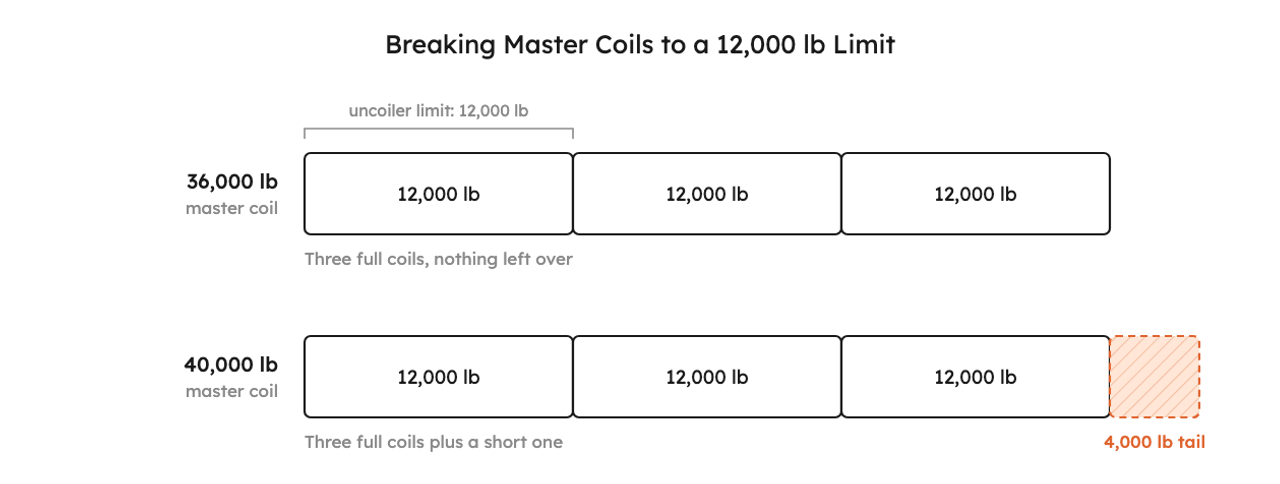
The arithmetic is easy, which is why it gets skipped. Take full width coil going to a line with a 12,000 lb limit like the one above. A 36,000 lb master breaks cleanly into three 12,000 lb coils. A 40,000 lb master gives three 12,000 lb coils and a 4,000 lb tail, and if the customer will not take a 4,000 lb coil, that tail is a remnant before anything ships. Four 10,000 lb coils might suit the order better, or a different master might, but the choice has to be made before the coil is loaded. Once weight limits sit in the plan next to the widths, the plan can pick masters that break cleanly and send the awkward weights to orders that can absorb them.
Rules that live in someone's head
Coating substitution is where a lot of planning knowledge hides. Shipping G90 against a G60 order is an upgrade some customers will accept, usually at the supplier's expense. Shipping G60 against a G90 order falls short of the spec. Which customers take the upgrade, and on which parts, is a rule that typically lives with one experienced planner or inside salesperson. When the plan cannot see that rule, it either passes over a usable coil or the planner overrides it by hand every time, and when that person is out, the rule is out with them.
Pre-painted coil adds a different constraint. Where a customer buys painted coil for cabinets or panels, the surface is part of the product. GalvInfo identifies lateral undercutting corrosion at a scratch in the paint or at a sheared edge as the most common paint adhesion failure on pre-painted sheet. Every extra break, rewind or re-handle is another chance to mark that surface, so fewer setups and fewer orphan pieces are worth more on painted work than on bare galvanized.
Planning across the customers
Put these together and most of the scrap on HVAC work traces back to a planning unit that is too small. A plan built one order or one customer at a time sees a few lines in a gauge and coating. A plan built across every open order in that gauge and coating, against the coils actually in inventory, can see the narrow strip that closes a drop, the second customer who can take the 4,000 lb tail, and the G90 coil that one account will happily accept on a G60 order. The coils and the orders stay the same; only the search gets wider.
The cost can be measured before anything changes. Setups per ton on HVAC work, compared with the rest of the book, shows how often small lots are being cut on their own. Remnant pounds by gauge and coating, aged past 60 and 90 days, shows where the odd combinations pile up, such as a heavy gauge in G90 at a width nobody reorders. A count of underweight tails from breaks last quarter shows what weight limits are costing. The scrap calculator turns those remnants into dollars, and the wider set of levers is covered in how to reduce scrap on a slitting line.
The search is the part software does well. LineSight AI builds slitting plans from open orders and live coil inventory in seconds, and every plan shows what is cut from which coil and why. A person approves the plan before anything goes into the ERP or to the floor. When a planner overrides it, for a coating rule or a customer who needs the order today regardless of yield, the override is kept and later plans respect it, so the rule stops depending on one person's memory. If you want to see that on your own HVAC orders, book a demo; the first three months are free.